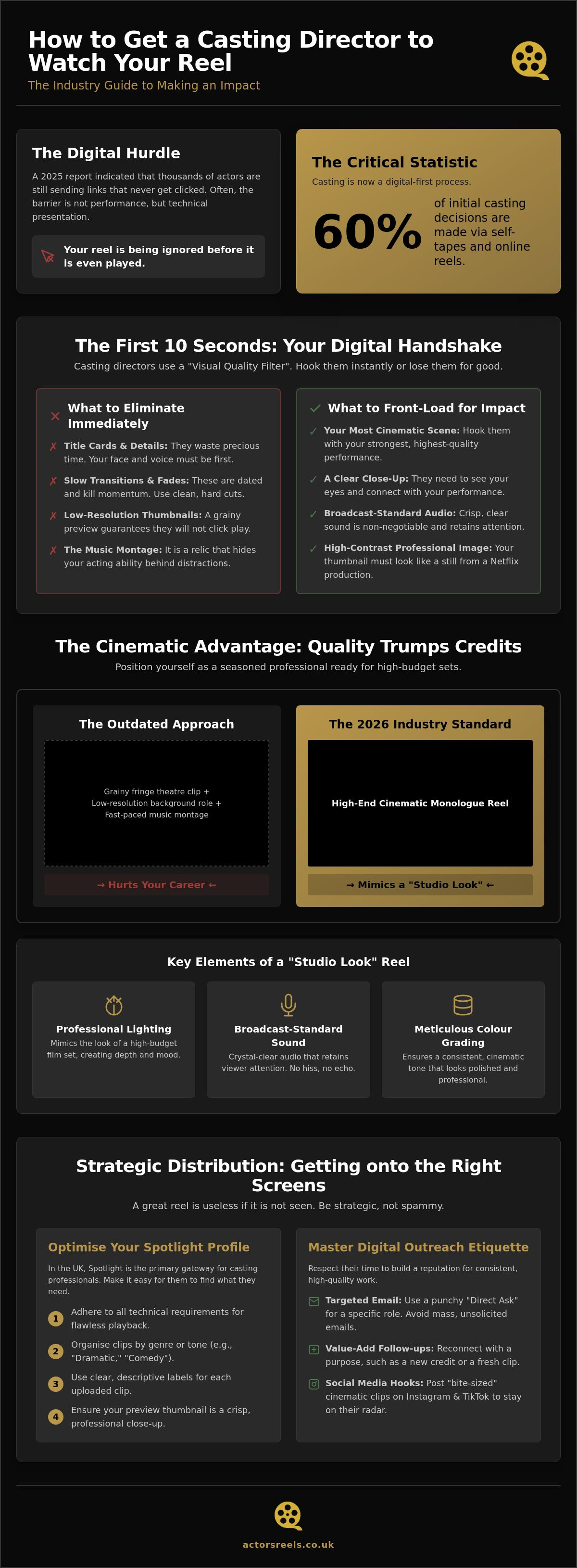
A 2025 report indicated that 60% of initial casting decisions are now made via self-tapes, yet thousands of actors are still sending links that never get clicked. You know the exhausting cycle of sending out hundreds of emails only to be met with total silence. It feels like shouting into a void whilst your peers land major auditions with ease. Often, the barrier isn't your performance, but the technical presentation of your work.
Discover the industry secrets regarding how to get a casting director to watch your reel by bypassing the "skip" button and ensuring they actually click play. Stop settling for amateur clips that don't do your ability justice. This guide breaks down the visual quality filters used by professionals, the necessity of cinematic production, and the strategic distribution methods that turn a digital resume into a results-driven asset. It is time to transform your presence into a performance that commands attention from the very first frame.
Key Takeaways
- Master the visual hook by front-loading your most cinematic performance to stop casting directors from hitting the skip button.
- Learn the strategic technical shifts required for how to get a casting director to watch your reel by favouring high-end production over dated montages.
- Optimise your Spotlight presence and professional outreach to ensure your footage is seen by the industry's key decision-makers.
- Understand why broadcast-standard audio is your most powerful tool for retaining a viewer's attention until the very last frame.
- Leverage the psychological impact of cinematic quality to position yourself as a seasoned professional ready for high-budget sets.
The First 10 Seconds: How to Hook a Casting Director Instantly
The first frame of your footage is your digital handshake. If it looks low-budget, the viewer has already checked out. In the casting process, time is the most expensive commodity. Casting directors use a "Visual Quality Filter" to manage the thousands of submissions they receive. If your thumbnail or opening shot looks like a home video, they won't even press play. Learning how to get a casting director to watch your reel starts with ruthless editing. You must eliminate the fluff. Title cards, contact details, and slow transitions are killing your watch time. They want to see your face and hear your voice immediately. Organise your Spotlight profile so the preview image is a crisp, high-contrast frame that demands a click.
Visual Standards in 2026: Why Quality Trumps Credits
A grainy clip from a fringe theatre production or a low-resolution background role won't help your career. In fact, it often hurts it. High-end cinematic monologue reels often outperform poor-quality TV credits because they mimic the "Studio Look" of a Netflix or BBC production. This requires professional lighting, broadcast-standard sound, and meticulous colour grading. When your footage looks like a finished film, you are subconsciously telling the director that you belong on a professional set. It is about presenting a result, not a work in progress. Quality is your most effective marketing tool.
The Death of the Montage
The era of the fast-paced music montage is over. It is a distraction that hides your acting. Today, casting directors prefer monologue reels that focus entirely on the performance. They need to see your eyes. A steady, cinematic close-up allows them to evaluate your range and emotional depth whilst avoiding the clutter of an upbeat soundtrack. To master how to get a casting director to watch your reel, you must front-load your most compelling work. Your best scene should be the first thing they see. If you don't hook them in ten seconds, you have lost them for good.
Strategic Distribution: Getting Your Reel onto the Right Screens
A cinematic reel is a powerful asset, but it's useless if it never reaches the right inbox. In the UK, Spotlight remains the primary gateway for casting professionals. Optimising your profile isn't just about uploading footage; it's about strategic placement. When considering how to get a casting director to watch your reel, you must think like a busy professional. They often filter by specific criteria, so your footage must be ready and accessible at the click of a button. Avoid the temptation to blast every casting office with unsolicited links. This behaviour often leads to being ignored. Instead, focus on a targeted "Direct Ask" via email. Keep your cover note punchy. State your suitability, link your reel, and justify why you are the right fit for the role.
Adhering to Spotlight Showreel Requirements
Compliance is the first step toward visibility. You must follow the Spotlight showreel requirements 2026 to ensure your media plays correctly on all devices. Organise your clips by tone or genre. Label them clearly, such as "Dramatic Monologue" or "Contemporary Comedy". This allows a CD to find exactly what they need in seconds. Remember that the production quality of your reel acts as a silent endorsement of your professionalism. If you need to refresh your digital presence, investing in our cinematic monologue showreels will help you stand out in a crowded market.
The Etiquette of the Digital Follow-up
Timing is everything. Sending your reel in the middle of a major casting call can result in it getting lost amongst the noise. Aim for "Value-Add" follow-ups. If you have a new credit or a fresh social media promo clip, use that as a reason to reconnect. Platforms like Instagram and TikTok are excellent for secondary hooks. Post "bite-sized" cinematic clips that showcase your range. This keeps you on a CD's radar without the friction of a formal email. Mastering how to get a casting director to watch your reel requires a distribution strategy that respects their time. It builds a narrative of consistent, high-quality work. This makes the decision to watch your full reel an easy one for any industry professional.
The Cinematic Advantage: Why Production Quality Dictates Watch Time
Production quality is your silent advocate. When a casting director sees high-end visuals, they subconsciously tag you as a "working professional" ready for a major set. It's a psychological trigger. High production value suggests that you are already vetted by the industry. If you want to know how to get a casting director to watch your reel until the end, you must prioritise technical excellence. This isn't just about looking good; it's about removing the friction that leads to a skip. Sound quality is your most critical retention tool. Bad audio is the primary reason viewers stop watching. If they have to strain to hear your performance, they will move on to the next submission in seconds.
Treat your monologue as a short film rather than a simple acting exercise. This approach showcases your screen presence and narrative depth. It positions you for the roles you want, rather than just the minor parts you've already had. You are selling a vision of your future career. For more foundational advice, you can find tips on putting together a great demo reel that cover the basics of content selection and length.
Investing in a Professional Monologue Production
There is a massive gap between a DIY recording and a studio-produced scene. Understanding how to get a professional actor showreel means recognising the value of a director. In a studio setting, a director ensures your performance is camera-ready and nuanced. They push you past the "self-tape" energy into a truly cinematic performance. This level of preparation is what separates a hobbyist from a professional. It ensures your reel stands out in an increasingly competitive 2026 market.
Customising Your Reel for Specific Castings
One static reel is no longer enough. The most successful actors maintain a library of high-end clips. This allows you to target different genres with surgical precision. If you are applying for a Period Drama, send a cinematic clip that reflects that specific aesthetic. For a Gritty Crime drama, use a monologue with high-contrast lighting and a darker tone. This level of customisation is the ultimate secret of how to get a casting director to watch your reel. You aren't just showing them that you can act; you are showing them that you already fit the world they are building.
Take Command of Your Casting Narrative
Your reel is more than just a collection of clips. It is a strategic tool designed to open doors that have previously remained shut. By mastering the visual hook and prioritising broadcast-standard audio, you eliminate the barriers between your talent and the industry's decision-makers. You now understand that how to get a casting director to watch your reel is about more than just hitting 'send'. It is about presenting a finished, cinematic product that mirrors the high-end productions you aim to join.
Stop letting amateur production values hold your career back. We provide professional studio-based filming in Manchester, delivering Red Dot level cinematic quality that demands respect. Every session includes full post-production and social media promo clips to ensure your digital presence is cohesive and impactful across every platform. Book your Cinematic Monologue Showreel at Actors Reels today and start competing at the highest level. Your next major role is waiting for a performance that looks as professional as you are.
Frequently Asked Questions
Do casting directors actually watch the whole reel?
Casting directors rarely watch a showreel from start to finish. Most industry professionals decide whether to continue watching within the first 10 to 30 seconds. If your opening clip doesn't capture their attention or demonstrate the specific qualities they are searching for, they will move on. They use your reel as a tool for elimination. Once they have seen enough to make a decision, they stop the video.
Should I put my best scene first or save it for the end?
You must always put your best scene first. Saving your strongest performance for the end is a common mistake that often results in it never being seen. Front-loading your most cinematic and compelling work is the most effective strategy for how to get a casting director to watch your reel. Start with a high-impact close-up that showcases your range immediately. This ensures your best work is the first thing they experience.
Can I use a self-tape as my main showreel on Spotlight?
Whilst you can use a self-tape on Spotlight, it is no longer the competitive standard for a primary showreel in 2026. Self-tapes often lack the professional lighting and cinematic depth required to stand out amongst thousands of submissions. To master how to get a casting director to watch your reel, you should opt for broadcast-quality footage. A cinematic monologue provides a level of professional authority that a standard self-tape simply cannot match.
How long should an actor showreel be in 2026?
An actor showreel should ideally be between two and three minutes long in 2026. However, the modern industry preference is shifting toward shorter, individual clips that are easily searchable. Casting directors have very limited time and prefer to see specific tones or genres quickly. Keep your footage concise and punchy. Every second must justify its place. If a scene feels slow or redundant, cut it to maintain momentum.