
A Spotlight profile without a showreel is practically invisible. Over 90% of UK television work is cast through this platform. You know your talent deserves a cinematic showcase. Yet, the technical maze of Spotlight showreel requirements often feels like a barrier to your next big role. It's frustrating to fear that a self-made reel looks amateurish or that your files won't meet the 2026 upload standards.
We understand that your focus should remain on the craft, not the codec. This guide clears the fog. It offers a definitive roadmap to mastering the technical and creative standards required to capture a casting director's attention in seconds. You'll learn how to navigate the 2026 specs, from the 720p resolution sweet spot to the ideal three-minute runtime. We'll examine the shift toward performance-led content, the best way to organise your clips, and the precise file formats needed to ensure your portfolio looks as polished as a professional production. Let's build a reel that doesn't just meet the requirements but advances your career.
Key Takeaways
- Master the technical specifications for 2026, including why MP4 (H.264) remains the industry standard for seamless playback.
- Understand the current Spotlight showreel requirements to ensure your profile meets the high-end standards expected by top UK casting directors.
- Learn why leading with a clear close-up and prioritising high-quality audio is far more effective than a dated, flashy montage.
- Discover how to avoid common pitfalls like copyrighted music or distracting title cards that can lead to your reel being skipped.
- Gain a competitive edge by using cinematic monologue showreels to showcase your talent with professional, studio-level production value.
Navigating Spotlight Showreel Requirements in 2026
Your showreel serves as your digital handshake. It is the first point of contact between your talent and the UK's most influential casting directors. In an industry where over 90% of television work is cast via a single platform, understanding the nuanced Spotlight showreel requirements is the difference between being shortlisted and being ignored. Spotlight remains the gold standard for professional representation because it demands a level of verified quality that other platforms lack. It is your professional shop window.
The 2026 landscape has shifted. Simply having "any footage" is no longer enough to compete. Since upload fees were removed, the volume of video content on the platform has increased. This means casting directors are more selective than ever. They don't just want to see that you can act; they want to see professional production values that reflect the standard of the sets they are casting for. Before diving into technical specs, it is helpful to define the core purpose of the medium. What is a Showreel? At its heart, it is a curated portfolio designed to prove your range and professional standard in under three minutes.
The Role of the Showreel in Modern Casting
Casting professionals use filters to manage thousands of applicants. The "actors with video" checkbox is the most common tool they use to narrow the field. If you lack a reel, you don't exist in their search results. You have exactly ten seconds to hook them. The lighting, the sound, and your performance must be immediate and high-end. Your reel must also align perfectly with your current "type" and headshots. If your video looks like a different person than your photos, you lose credibility instantly. Consistency builds trust.
Spotlight Guidelines vs. Industry Expectations
There is a significant gap between what the platform allows and what agents prefer. Spotlight provides a broad technical framework, but industry expectations are far more precise. While the system accepts various file formats and longer runtimes, navigating the latest Spotlight showreel requirements means opting for brevity and cinematic clarity. Professionals want a two-minute reel that feels like a film, not a five-minute montage that feels like a home movie. Even for newcomers, 2026 standards demand a level of visual polish that matches the high-end productions of modern streaming services.
Organisation also impacts your visibility. Correctly titling your clips with character names and genres helps the platform's internal search algorithm. A well-organised, high-quality profile is more likely to appear at the top of a director's results. It shows you are a professional who respects the casting director's time and understands the mechanics of the industry.
Technical Specifications: Format, Length, and Quality Standards
Technical precision is the foundation of a professional portfolio. It isn't just about meeting a platform's minimum criteria. It's about ensuring your performance isn't undermined by poor compression or playback errors. To truly master Spotlight showreel requirements, you must treat your digital files with the same rigour as a production house treats a final master. Casting directors work at pace. They expect files that load instantly and look pristine on high-resolution displays.
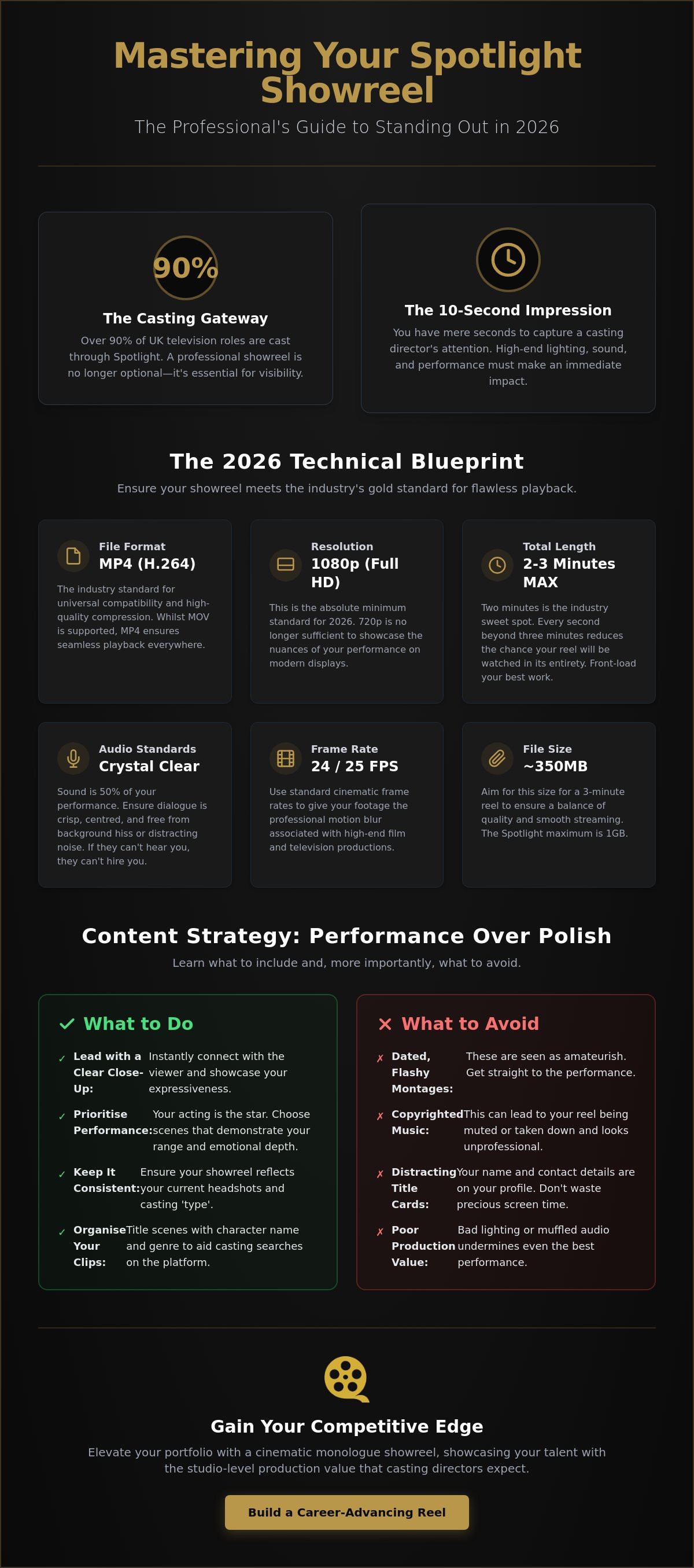
The industry standard for file formats remains MP4 using the H.264 codec. This combination offers the most reliable balance between high visual quality and manageable file sizes. Whilst Spotlight supports various formats like MOV and AVI, MP4 ensures universal compatibility across all devices. Regarding resolution, ignore the suggestion that 720p is enough. In 2026, 1080p (Full HD) is the absolute minimum standard for a professional actor. It provides the clarity needed for a director to see the nuance in your eyes without bloating the file beyond the 1GB limit. Aim for a file size of approximately 350MB for a three-minute reel to ensure smooth buffering.
Length is your most critical creative constraint. Two minutes is the industry sweet spot. Three minutes is the absolute maximum. If your best work isn't front-loaded within the first thirty seconds, you've already lost your audience. Every frame must earn its place.
The 2026 Technical Checklist
- Frame Rates: Stick to 24fps or 25fps. These rates provide the cinematic motion blur associated with high-end film and television.
- Audio Standards: Sound is 50% of the experience. Ensure your dialogue is clear, centred, and free of ambient hiss. If they can't hear your performance clearly, they won't hire you.
- Aspect Ratio: Stay with 16:9 widescreen. It remains the professional standard for narrative storytelling, regardless of social media trends.
Uploading and Organising Your Media
Organisation reflects your professional attitude. Don't upload a file named "Showreel_Final_v2.mp4". Use a clear, searchable convention such as Name_Role_Genre. This allows casting directors to identify your suitability at a glance. Your thumbnail choice is equally vital. Select a high-impact close-up that matches your current headshots to encourage that initial click.
Spotlight provides 20 minutes of total storage. Use this space wisely by uploading several short, targeted scenes rather than one long, rambling montage. This modular approach allows you to send specific clips that match a particular casting brief. If your current footage doesn't meet these high-end specs, cinematic monologue showreels provide a streamlined way to secure a studio-quality portfolio that ticks every technical box.
Content Strategy: Why Performance Trumps Production History
The montage is dead. Casting directors no longer have the patience for thirty-second musical intros, flashy title cards, or fast-cut "action" sequences. They want to see you act. Immediately. Modern Spotlight showreel requirements demand that you get straight to the point. Your first shot must be a clear, well-lit close-up. Don't hide behind wide shots or busy backgrounds. The industry wants to see the nuance in your performance from the very first frame. If you don't hook them in the first ten seconds, they've already moved on to the next profile.
Most advice assumes you already have a library of broadcast clips from the BBC or Netflix. For many talented actors, this isn't the reality. Padded reels filled with grainy student films or poorly recorded theatre clips actually damage your professional brand. They signal "amateur" before you've even spoken a line. A single, high-quality cinematic scene is infinitely more powerful than five mediocre ones. Casting professionals advise that one strong scene is more effective than a longer showreel padded with weaker material. It's about the quality of the acting, not the quantity of the credits.
The "Solo Scene" Advantage
You don't need a multi-actor set to prove your worth. A solo scene, when executed with cinematic precision, allows the viewer to focus entirely on you. The key is material selection. Avoid overdone "classic" monologues that casting directors have heard a thousand times. Pick contemporary, grounded material that fits your "type" perfectly. In a controlled studio environment, we can ensure the lighting and sound match the standards of a professional film set, making your "self-made" content indistinguishable from broadcast footage.
Addressing the #1 Objection: "I Need a Scene Partner"
Actors often worry that performing alone looks like a "drama school" exercise. The opposite is true. A tight close-up on a solo performance is often more useful to a casting director because there are no distractions. They aren't looking at your scene partner; they are looking at how you listen, how you react, and how you hold the lens. High-end production value replaces the need for "location" filming. Professional lighting creates depth, whilst clean audio ensures every emotional beat lands. You aren't just showing them you can act; you're showing them you belong on a professional set. Focus the viewer’s attention entirely on your emotional range and let the production quality do the rest of the heavy lifting.
Common Mistakes That Get Your Reel Skipped
Casting directors are notoriously time-poor. They often view hundreds of profiles for a single role. A single amateur error in your footage doesn't just look bad; it ends your consideration for the project. Navigating the complexities of Spotlight showreel requirements means identifying these red flags before you hit upload. If your reel doesn't scream "professional" within the first five seconds, you've already lost the room.
Audio is non-negotiable. It's the fastest way to make a professional hit the mute button. If a casting director has to strain to hear your dialogue over a distracting background hum or a poorly mixed score, they'll simply move on. Similarly, using copyrighted music is a significant risk. Spotlight is clear on this: performers are responsible for clearing rights. The platform will remove any material involved in a copyright dispute. Avoid distracting title cards and flashy graphics. Your name and contact details belong in your profile text, not as a ten-second intro on your video.
Never include "extra" work or unidentifiable background roles. If the viewer has to play "Where's Wally" to find you, the reel has failed. Your footage must feature you as the primary focus. Additionally, be ruthless with outdated material. If you've changed your hair, aged significantly, or shifted your casting bracket, that footage from three years ago has to go. It creates a disconnect that kills your credibility during a live audition.
The Technical Red Flags
Vertical video has no place in a professional portfolio. It's a format for social media, not for cinematic storytelling. Always shoot in 16:9. Watch out for the "lip-sync lag" where audio and video become slightly unsynced. This technical glitch is incredibly jarring and suggests a lack of attention to detail. Avoid over-editing. Flashy transitions and "creative" filters only serve to distract from your acting. Keep the cuts clean and the focus on your face.
The Creative Red Flags
Don't start with a black screen or a long list of credits. Lead with your best performance immediately. Avoid playing characters that are too far outside your current casting bracket. If you're a twenty-something actor, don't include a scene where you've been aged up with poor make-up to play a CEO. It looks amateurish. Ensure you are always the primary focus of every shot. If the most interesting person in the scene isn't you, cut it. To ensure your portfolio remains free of these career-stalling mistakes, invest in a professional cinematic showreel that meets every industry standard.
Elevating Your Portfolio with Cinematic Monologue Showreels
Waiting for the perfect broadcast credit is a passive career strategy. In 2026, the most successful actors are those who take ownership of their visual brand. Actors Reels bridges the gap between drama school training and the professional sets of major UK broadcasters. We provide the cinematic evidence of your talent before you've even stepped onto a professional soundstage. This isn't a luxury. It is a results-driven necessity for anyone serious about their career advancement. You are providing casting directors with the visual proof they need to take a risk on a new face.
Studio-based filming offers a level of control that location shoots cannot match. By eliminating external noise and unpredictable lighting, we ensure your performance remains the absolute focus. This controlled environment is essential for meeting the high-end Spotlight showreel requirements that casting directors now demand. Every frame is crafted to highlight your range. We ensure your digital portfolio reflects the quality of a premium television production. Navigating the Spotlight showreel requirements in 2026 means presenting a portfolio that looks as expensive as the projects you want to book.
The Actors Reels Approach
Our approach focuses on creating cinematic monologues that mirror the aesthetic of high-end TV drama. We don't believe in the "theatre-on-film" look. We use industry-standard optics and lighting to create depth and texture. Because we focus on the individual, you don't need to coordinate with a scene partner. We capture your emotional transitions in tight, meaningful close-ups. The result is a streamlined production process. We move from studio filming to Spotlight-ready files with maximum efficiency and zero friction.
Next Steps for Your Spotlight Profile
Unified branding is the final piece of the puzzle. By combining our cinematic scenes with our Headshot Add-ons, you create a cohesive visual identity across your entire profile. When a casting director sees your thumbnail and then watches your reel, the transition must be seamless. It builds a sense of professional reliability. It shows you understand the mechanics of the industry.
Evaluate your current footage against the 2026 standards we've outlined. If your reel feels dated or lacks the cinematic polish of modern drama, it's time for a refresh. Don't let technical limitations hold back your creative potential. Invest in a portfolio that works as hard as you do. Take the next step in your professional journey and Book your Cinematic Monologue Session with Actors Reels today.
Secure Your Casting Future
Mastering Spotlight showreel requirements is no longer just about technical compliance. It's about professional survival. The 2026 landscape demands cinematic quality, immediate impact, and surgical precision in your file organisation. A grainy student film or a cluttered montage won't cut it when casting directors are filtering for excellence. Your portfolio must reflect the standard of the sets you want to work on.
Your reel is your most powerful advocate. It must look like the high-end TV drama you aspire to join. By prioritising clean audio, Full HD resolution, and a performance-first strategy, you position yourself as a results-driven professional. This is a direct investment in your career's forward momentum. Don't leave your first impression to chance.
Take the lead and create a Spotlight-ready cinematic reel with Actors Reels. As cinematic monologue specialists, we provide premium studio production in the UK with expert industry-standard editing and sound. Your talent deserves a showcase that matches your ambition. Let's get to work.
Frequently Asked Questions
How long should a Spotlight showreel be in 2026?
A single showreel should ideally be between two and three minutes long. Whilst Spotlight allows you to upload up to 20 minutes of video content, casting directors rarely watch beyond the two-minute mark. Brevity is essential. Any reel exceeding five minutes is likely to be skipped as it suggests a lack of professional curation. Focus on your strongest work and cut the rest.
Can I include a self-tape on my Spotlight profile?
Yes, you can include high-quality self-tapes to demonstrate your current range. Ensure the lighting and audio meet professional standards. Spotlight suggests that 720p resolution is sufficient for these clips to manage file sizes. However, a cinematic monologue filmed in a studio provides a far more authoritative impression than a standard home recording. Use self-tapes as supplementary material rather than your primary showcase.
What is the best file format for uploading to Spotlight?
The preferred file format to meet Spotlight showreel requirements is MP4 using the H.264 codec. This ensures your video plays smoothly across all devices and browsers. Aim to keep a five-minute video under 350MB to avoid buffering issues. Whilst the system supports .MOV and .AVI, the MP4 format remains the industry standard for reliable, high-quality playback in the UK casting industry.
Do I need professional credits to have a showreel on Spotlight?
You do not need broadcast credits to have a professional presence on the platform. In 2026, a showreel is considered non-negotiable for all members. Profiles without video are now the exception and are frequently overlooked. If you lack footage from professional sets, a cinematic monologue showreel provides a high-end alternative that proves your talent to casting directors without needing a prior television credit.
Should I put my best scene first or follow a chronological order?
Always lead with your best and most relevant scene. Casting directors decide whether to keep watching within the first ten seconds. Chronological order is irrelevant to a professional who needs to see your talent immediately. Front-load your reel with your strongest performance and your most current look to ensure you grab their attention before they move on to the next profile.
Is it better to have one long reel or several individual clips?
It is significantly better to upload several short, targeted clips. This modular approach allows you to label scenes by genre, such as "Contemporary Drama" or "Sitcom". It makes your profile easier to navigate for busy professionals. Over 90% of UK television work is cast on Spotlight, and directors prefer clicking a specific, well-titled clip that matches their current brief rather than scrubbing through a long montage.
Can I use a monologue I filmed myself at home?
You can use home-filmed material, but it often struggles to meet the Spotlight showreel requirements for professional quality. Poor lighting, distracting backgrounds, and hollow audio can make even a great performance look amateurish. In a competitive market, your footage must compete with broadcast-quality scenes. Investing in a studio-produced monologue ensures your technical standards match your creative ambitions and builds immediate trust with agents.
How often should I update my Spotlight showreel?
Refresh your showreel whenever your physical appearance or casting "type" changes significantly. This includes major changes to your hair, age, or general look. You should also update your footage whenever you secure a scene that offers higher production value or a more nuanced performance. Keeping your reel current ensures that when you finally get the audition, the person who walks into the room matches the actor on the screen.


