Your scene partner is likely the biggest distraction on your showreel. In a competitive industry where casting directors decide your fate in seconds, sharing the spotlight is a risk you don't need to take. Creating an actor showreel without scene partner is no longer a compromise or a budget-saving shortcut. It's the new industry standard for high-end, professional self-representation.
We understand the frustration of trying to coordinate schedules with other actors only to find yourself overshadowed in the final edit. It's your career on the line, yet your best footage often depends on someone else's performance. You'll discover why a solo cinematic monologue is actually more effective for catching a casting director’s eye than a traditional multi-actor scene. This guide breaks down the shift in industry expectations, clarifies Spotlight requirements for solo content, and explains how to lead with a high-impact performance that keeps the focus exactly where it belongs: on you.
Key Takeaways
- Understand the industry shift toward solo cinematic monologues that capture attention faster than traditional multi-actor scenes.
- Discover how an actor showreel without scene partner eliminates the risk of being overshadowed while showcasing your unique screen presence.
- Learn how to select "active" scripts that imply an invisible partner to ensure your performance feels grounded and authentic.
- Explore the strategic benefits of building a portfolio with short, high-end clips rather than relying on one long, cluttered reel.
- Gain the confidence to submit solo content that meets the latest Spotlight standards and professional casting expectations.
Debunking the Myth: Do You Really Need a Scene Partner for a Professional Reel?
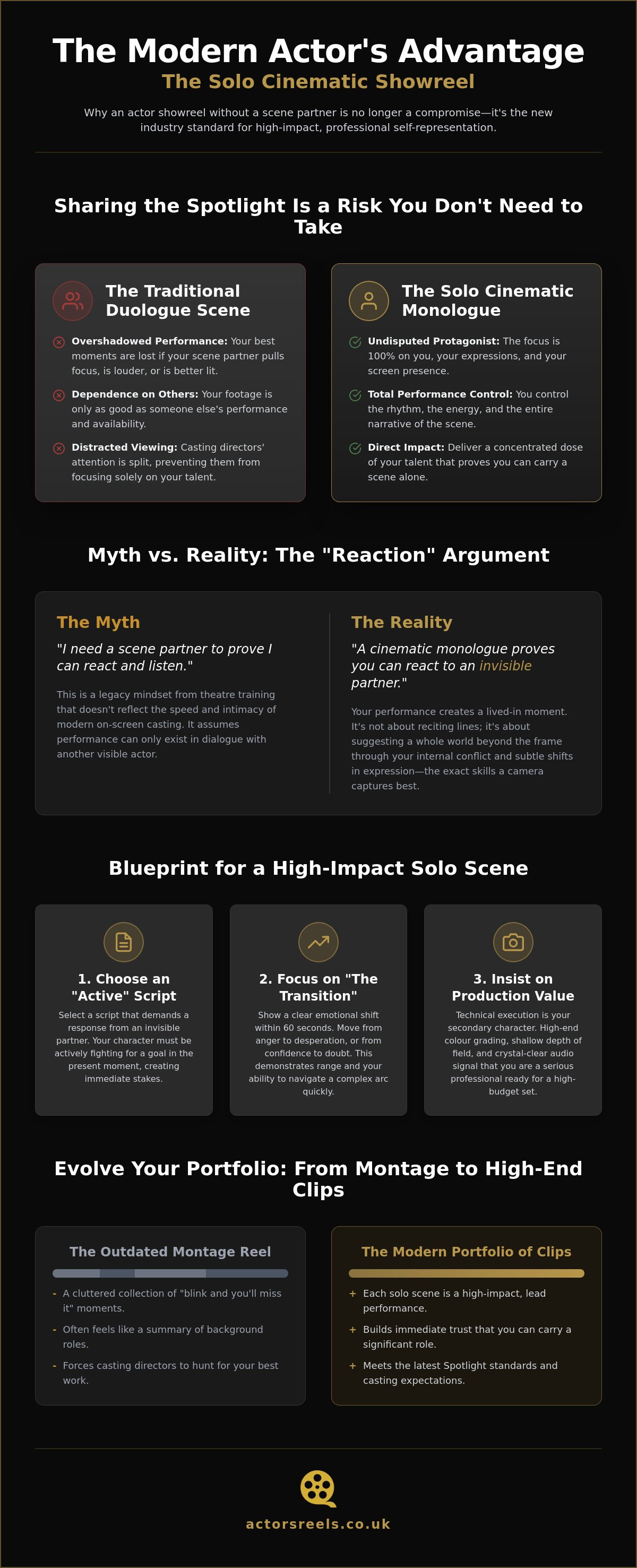
Many actors believe they need a scene partner to prove they can "react." This is a legacy mindset that no longer reflects how modern casting works. A high-end solo showreel is a cinematic monologue designed specifically for the digital age. It isn't a stage performance; it's a tight, intimate window into your screen presence. You aren't just reciting lines to a wall. You're creating a lived-in moment that suggests a whole world beyond the frame.
Understanding What is a Showreel? is the first step toward effective self-marketing. Traditionally, it was a long montage of past work. Today, it’s a focused sales tool. The industry has moved away from multi-actor montages because casting directors lack the time for slow builds. They need to see you, and only you, within the first few seconds. An actor showreel without scene partner isn't a backup plan. It's a strategic choice to put your talent front and centre.
Choosing a solo production removes the "distraction factor." We’ve all seen reels where the other actor is better lit, has a more compelling voice, or accidentally pulls focus during your emotional peak. In your own reel, you shouldn't have to fight for the viewer's attention. A solo reel ensures you are the undisputed protagonist. It eliminates the risk of being overshadowed by a partner who might be more experienced or simply louder.
There’s a common misconception that monologues belong only in theatre or drama school. That isn't true for professional cinematic monologues. These are written and shot with film grammar in mind. They focus on internal conflict and the subtle shifts in expression that a wide-angle multi-actor scene often misses. It’s about proving you can hold the camera's gaze without needing someone else to lean on.
Why Casting Directors Prioritise Your Individual Screen Presence
Casting directors make decisions at lightning speed. They want to see your eyes, your stillness, and your immediate reactions. A solo reel maintains a professional pace by stripping away unnecessary dialogue from a partner. It allows you to demonstrate your range without the friction of a second performer. You control the rhythm. You control the energy. Most importantly, you control the narrative of your own career.
Deciding between a single monologue reel vs montage is a critical career move. A montage often feels like a collection of background roles or "blink and you'll miss it" moments. A solo cinematic monologue feels like a lead performance. It proves you can carry a scene alone. This builds immediate trust with casting professionals who need to know you can handle the pressure of a significant role without a safety net.
Crafting the Perfect Solo Scene: From Script Selection to Cinematic Execution
Choosing a script for an actor showreel without scene partner requires a specific lens. You aren't looking for a passive reflection or a long-winded story about the past. You need a script that demands a response from an "invisible" partner. This creates a sense of active listening and immediate stakes. The audience should feel the presence of the other person through your reactions. It is about the character trying to achieve a specific goal in the present moment. You must be fighting for something, even if the person you're fighting with isn't in the frame.
Focus on "the transition." Casting directors need to see your range quickly. Aim for a clear shift in emotion or tactic within the first 60 seconds. If you start with cold anger, find the moment where that breaks into desperation or sudden calculation. This movement proves you can navigate a complex arc in a short timeframe. When Crafting a Professional Demo Reel, these subtle shifts are what separate a student piece from a professional calling card. An actor showreel without scene partner is often more revealing than a shared scene because there is nowhere to hide.
The Technical Edge: Why Production Value Matters for Solo Reels
A solo reel lives or dies on its production value. Without a scene partner to share the frame, the technical execution becomes your secondary character. A professional monologue recording uses shallow depth of field to separate you from the background. This directs the viewer’s eye exactly where it needs to be. High-end colour grading adds a cinematic texture that a mobile phone simply cannot replicate. It signals that you are a serious professional ready for a high-budget set.
Audio is equally critical. Clear, studio-quality sound is non-negotiable. If the audio is thin or echoey, the immersion breaks immediately. Professional lighting creates shape and mood, elevating the performance from a simple self-tape to a genuine piece of film. If you're ready to elevate your presence, you can book a cinematic session to ensure your solo work stands out in a crowded market.
Maximising Your Portfolio with a Professional Monologue Production
Your portfolio needs a definitive centrepiece. An actor showreel without scene partner serves as your primary cinematic calling card for 2026. It is no longer about having the most footage. It is about having the best footage. Modern casting sites allow you to tag specific clips with genres or character types. Having three distinct, high-quality solo scenes is far more valuable than one cluttered montage where your best work is hidden in the middle.
Think of your monologue as a modular asset. Use social media promo clips to tease your performance across different platforms. These short, punchy edits create momentum. They build your professional profile whilst leading viewers directly to your full-length work. This strategy ensures your talent is visible exactly where casting directors are looking. It turns a single performance into a multi-channel marketing campaign for your career.
A solo cinematic monologue is the ultimate proof of craft. It shows you can hold the screen, command attention, and deliver a nuanced performance without relying on others. This level of self-sufficiency is highly attractive to production houses and directors. They want actors who are prepared, professional, and capable of delivering under pressure. Your solo reel is the evidence they need to make that call.
Meeting Spotlight Standards with Individual Performance
Platforms like Spotlight are evolving to favour individual clips over long montages. Understanding the Spotlight showreel requirements 2026 is essential for staying discoverable. For a solo monologue, the ideal length is usually between 60 and 90 seconds. This is long enough to establish a character arc but short enough to respect a busy professional's time. Before you hit record, review the actor’s checklist for monologues to ensure every technical and creative detail is polished. A precise, high-end actor showreel without scene partner is the most efficient way to demonstrate you are ready for the next level.
Take Control of Your Casting Narrative
The industry has shifted. Success now belongs to actors who understand that their reel is a precision tool, not a historical archive. By choosing a solo cinematic monologue, you eliminate the noise and place your screen presence exactly where it needs to be: front and centre. You've seen that an actor showreel without scene partner isn't just a convenience. It's a high-end strategy to meet modern Spotlight standards and capture a casting director's attention in seconds.
Precision matters. Our cinematic studio-based filming and expert industry-standard post-production ensure your work looks and sounds like a major film production. We build reels designed specifically for Spotlight and major agencies, giving you the professional edge required in a competitive market. Don't leave your career advancement to chance or rely on the performance of others to showcase your unique talent.
Ready to elevate your portfolio? Book your professional cinematic monologue session today and start winning the auditions you deserve. Your talent is ready for the spotlight; it's time the industry saw it clearly.
Frequently Asked Questions
Is an actor showreel without a scene partner acceptable for major UK agencies?
Yes, an actor showreel without scene partner is absolutely standard for major UK agencies and casting directors. They value the clarity it provides. Agents want to see your specific screen presence without the distraction of a co-star. A high-end solo reel demonstrates your ability to carry a scene alone. This is a vital indicator of professional readiness that helps you stand out in a crowded market.
How long should a solo monologue showreel be in 2026?
Individual solo monologue clips should ideally last between 60 and 90 seconds. For a complete showreel in 2026, the total length is considered to be between 2 and 3 minutes. Casting directors often make decisions in the first few seconds. Prioritising your strongest, most impactful solo work at the start is essential for immediate engagement. Short, punchy clips are more effective than long, rambling scenes.
Can I use a self-tape as a professional showreel if I don't have a partner?
You can use a self-tape, but there is a massive gap between a home recording and a professional cinematic production. While self-taped monologues are cost-effective, they often lack the professional lighting, studio-quality audio, and depth of field found in a high-end reel. Casting directors are increasingly wary of overly produced "fake" cinematic reels, yet they still respond to genuine, high-production value that reflects professional standards.
What are the best types of monologues for a cinematic showreel?
The best monologues for a cinematic reel are "active" scripts written in the present tense. Avoid "storytelling" monologues that focus on the past. Instead, choose a scene where your character is trying to achieve a specific goal or influence an invisible partner. This creates immediate stakes. It allows you to demonstrate emotional transitions and subtle shifts in tactic within a tight, one-minute window.