What if that glossy three-minute montage you've spent years perfecting is the very thing stopping you from getting called into the room? It's a common frustration. You've curated your best clips, yet the phone stays silent and your Spotlight profile feels stagnant. Many actors worry their current footage looks amateur or fails to meet the increasingly sharp standards of modern casting. The debate over a single monologue reel vs montage has never been more critical than it is in 2026. You deserve a portfolio that reflects your professional calibre rather than a fragmented collection of student film leftovers.
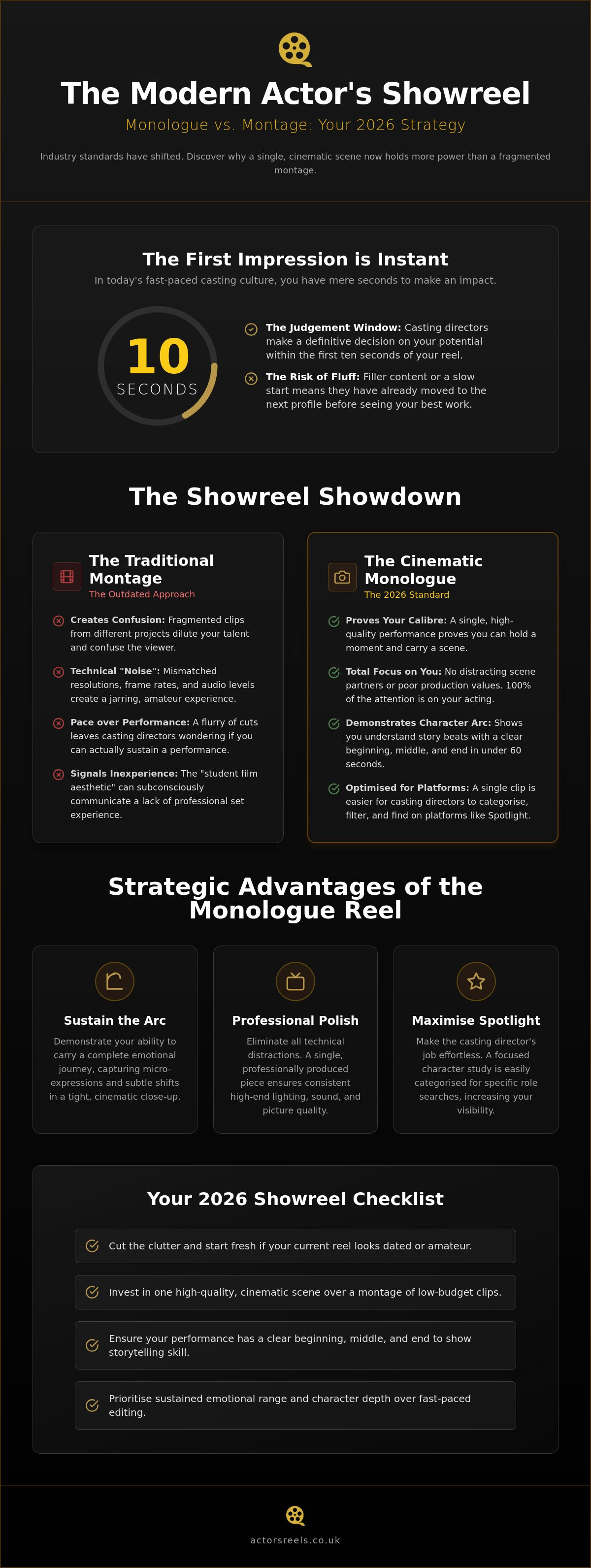
Industry standards have shifted. Casting directors now make a definitive judgement within the first ten seconds of your reel. They aren't looking for a high-speed edit of your life story. They want to see sustained, high-end performance that proves you can carry a scene. In this guide, you'll discover why the traditional montage is losing its grip and which specific showreel format will actually secure your next audition. We'll provide the clarity you need to move from being ignored to becoming a results-driven professional. It's time for a reel that demands a second look.
Key Takeaways
- Understand why the first ten seconds of your footage now dictate your audition success in a fast-paced casting environment.
- Discover the strategic shift of single monologue reel vs montage and why sustained emotional range beats fragmented editing.
- Learn how to identify when your current montage is holding your career back and requires a cinematic upgrade.
- Gain clarity on modern industry requirements to ensure your Spotlight profile looks like a high-end professional investment.
- Master the art of the hook to drop casting directors immediately into a moment of high emotional stakes.
The Evolution of the Showreel: Why the Classic Montage is Losing Ground
The traditional "greatest hits" reel is a relic of a slower industry. It relies on volume over value. In 2026, casting directors have zero patience for fluff or filler. They need to see your talent instantly. The history of the term 'reel' shows how the industry transitioned from physical film canisters to digital files. Today, that digital file must perform like a high-end production. When weighing up a single monologue reel vs montage, the deciding factor is often the first ten seconds. Fragmented clips from five different projects often create more confusion than clarity for the viewer.
The Psychology of the Casting Director in 2026
UK casting offices operate in a fast-forward culture. If you don't hook them in ten seconds, they've already moved to the next profile. A single, high-quality character study builds immediate trust. It proves you can hold a moment and sustain a character arc. Five low-budget scenes with poor scene partners only dilute your professional calibre. You want them focused on your performance. Don't make them work to find you amongst the chaos of a busy scene. Capturing your essence in a controlled environment is far more effective than hoping they spot your talent in a poorly lit student film.
Technical Flaws of the Traditional Montage
Montages are often plagued by technical "noise" that distracts from your acting. Mismatched frame rates, varying resolutions, and inconsistent audio levels create a jarring experience for the viewer. This "student film aesthetic" subconsciously signals a lack of professional experience to a high-end production team. The distraction factor in fragmented reels is a silent career killer. It forces the viewer to adjust to new lighting and sound every thirty seconds rather than connecting with your emotional truth. When you choose a single monologue reel vs montage, you eliminate these technical hurdles entirely. A professional production requires consistency. Your reel should reflect that same standard of excellence.
Performance vs Pace: The Strategic Advantages of a Single Monologue Reel
A montage often prioritises pace over depth. It is a flurry of cuts that leaves a casting director wondering if you can actually hold a scene. When you choose a single monologue reel vs montage, you reclaim control of the narrative. This format focuses 100% of the attention on your performance. There are no distracting scene partners or low-quality backgrounds to hide behind. While some traditionalists still point to the classic guide to demo reels as a reason to show variety, the 2026 market demands surgical precision. You need to prove you have the emotional stamina to carry a role.
Sustaining the Character Arc
Powerful screen acting isn't just about speaking. It's about how you listen and react. A cinematic monologue allows you to demonstrate a complete character arc within sixty seconds. The use of a tight close-up enhances your screen presence. It captures every micro-expression and subtle emotional shift. Ensure your piece has a definitive beginning, middle, and end. This structure proves you understand story beats. It shows you're ready for the technical demands of a professional set. If you want to elevate your presence, consider how cinematic production can transform a simple monologue into a high-end calling card.
Maximising the Spotlight Profile
Spotlight's interface has evolved. The "clips" feature is now the primary way casting directors filter talent. A single monologue is significantly easier to categorise for specific role searches. It allows you to align perfectly with Spotlight showreel requirements 2026. By uploading a focused character study, you make the casting director's job effortless. They don't have to scrub through a three-minute montage to find your dramatic range. For the best results, consult the checklist on what to include in a monologue showreel to ensure your content selection matches your current casting type.
Investing in Your Career: Making the Transition to Cinematic Quality
Stop treating your career like a creative hobby. If your current footage looks dated or amateur, it's time to cut the montage and start fresh. A cluttered reel with poor lighting signals a lack of professional standards to a casting director. You need a tool that works as hard as you do. When deciding on a single monologue reel vs montage, remember that production calibre is your strongest currency. A cinematic production separates you from the amateur crowd instantly. It transforms your profile from a collection of clips into a targeted professional asset.
The ROI of High-End Production
High-end production value justifies a higher day rate. It signals to producers and agents that you're a safe, professional investment. You don't need a massive budget to achieve world-class results. You can secure the "London look" without the London price tag by utilising the Manchester studio advantage. This provides the technical consistency and controlled lighting that home setups simply cannot match. Professionally produced cinematic monologue reels act as a digital calling card that opens doors in 2026. They prove you're ready for the big screen before you even step on set.
Next Steps for Your Portfolio
Preparation is everything. Treat your studio shoot like a day on a professional film set. Rehearse your piece until the emotional beats are second nature. This allows the director to focus on refining your performance rather than technical corrections. Ensure your new footage integrates seamlessly with your headshots and social media clips for a unified brand. A consistent professional image builds trust with casting offices. It's time to take the leap and upgrade your presence. Book your cinematic monologue session today and start converting your profile views into high-stakes auditions.
Take Command of Your Casting Narrative
The shift in the UK casting landscape is undeniable. Casting directors in 2026 value clarity and immediate impact over long-form compilations. When weighing up a single monologue reel vs montage, the decision is no longer just a stylistic preference; it's a strategic career move. You now understand why sustained performance and technical consistency are the new industry gold standards. It's time to stop letting fragmented, poor-quality clips define your professional brand.
Your reel is your most powerful digital calling card. It must reflect the high-end production value of the professional sets you aim to work on. Our professional Manchester-based studio provides cinematic 4K production standards to ensure your talent is undeniable. We offer these high-end results at a rate that is competitively priced for professional actors. This is about making your talent the sole focus of every viewing.
Upgrade your portfolio with a Cinematic Monologue Showreel today. Don't wait for the industry to move on without you. Take the lead, refine your presence, and secure the auditions you deserve. Your next breakthrough is just one cinematic scene away.
Frequently Asked Questions
Is a single monologue reel enough for a Spotlight profile in 2026?
Yes, a single cinematic monologue is absolutely sufficient for a Spotlight profile. Modern casting directors prioritise individual clips that demonstrate specific casting types rather than long, rambling montages. By uploading one high-calibre performance, you make your profile easier to navigate and categorise. This focused approach ensures your best work is seen immediately without the distraction of dated student film footage.
How long should a single monologue reel be to keep a casting director engaged?
Your monologue should typically be between 60 and 90 seconds in length. This duration provides enough time to establish a character and execute a meaningful emotional shift. Remember that the first ten seconds are the most critical for making an impression. Keeping your reel concise respects the viewer's time whilst proving you can deliver a powerful performance under pressure.
Can I include a montage and a single monologue on my acting portfolio?
You can include both, but they should be kept as separate files on your profile. When debating a single monologue reel vs montage, the monologue should serve as your primary showcase for talent and range. Use the montage as a secondary asset to demonstrate your on-set experience if the footage is of a professional standard. Never combine them into a single video, as this often leads to a jarring viewing experience.
What is the main difference between a self-tape and a cinematic monologue reel?
The primary difference is production value and intent. A self-tape is a fast, reactive response to a specific audition, often filmed with a basic home setup. In contrast, a cinematic monologue reel is a permanent marketing tool produced with studio-grade lighting, 4K cameras, and professional sound design. It's designed to position you as a high-end professional before you even step into the audition room.