

Your three-minute showreel isn't showing off your range; it's likely killing your chances of an audition. In 2026, casting directors make their decision within the first ten to thirty seconds. Every second of filler or low-quality footage increases the risk of them clicking away. If you've been asking how long should an acting showreel be to stay competitive, the industry has moved decisively toward brevity. A sixty-second cinematic masterclass now carries more weight than a three-minute montage of student film scraps.
It is natural to feel anxious about a lack of professional credits or the specific technical requirements of Spotlight. You want a portfolio that commands respect and gets watched to the very end. This article outlines the exact duration standards casting directors demand in the current UK market. We will show you how to replace dated, fragmented scenes with high-impact cinematic footage that mirrors the quality of a major streaming platform. You'll learn why the most successful actors are choosing shorter, studio-based monologues to showcase their individual range with maximum efficiency and professional authority.
Key Takeaways
- Learn exactly how long should an acting showreel be in 2026, with the industry now favouring a tight 60 to 90-second duration.
- Discover why casting directors often make their final decision within the first 15 seconds and how to hook them instantly.
- Understand why a single, high-production-value cinematic monologue outperforms a fragmented montage of student film clips.
- Master the art of showreel structure by leading with your most impactful performance to ensure you are seen as camera-ready for major UK productions.
- Ensure your digital portfolio remains professional by aligning your current physical look with your reel to avoid confusing industry gatekeepers.
The 2026 Industry Standard: How Long Should an Acting Showreel Be?
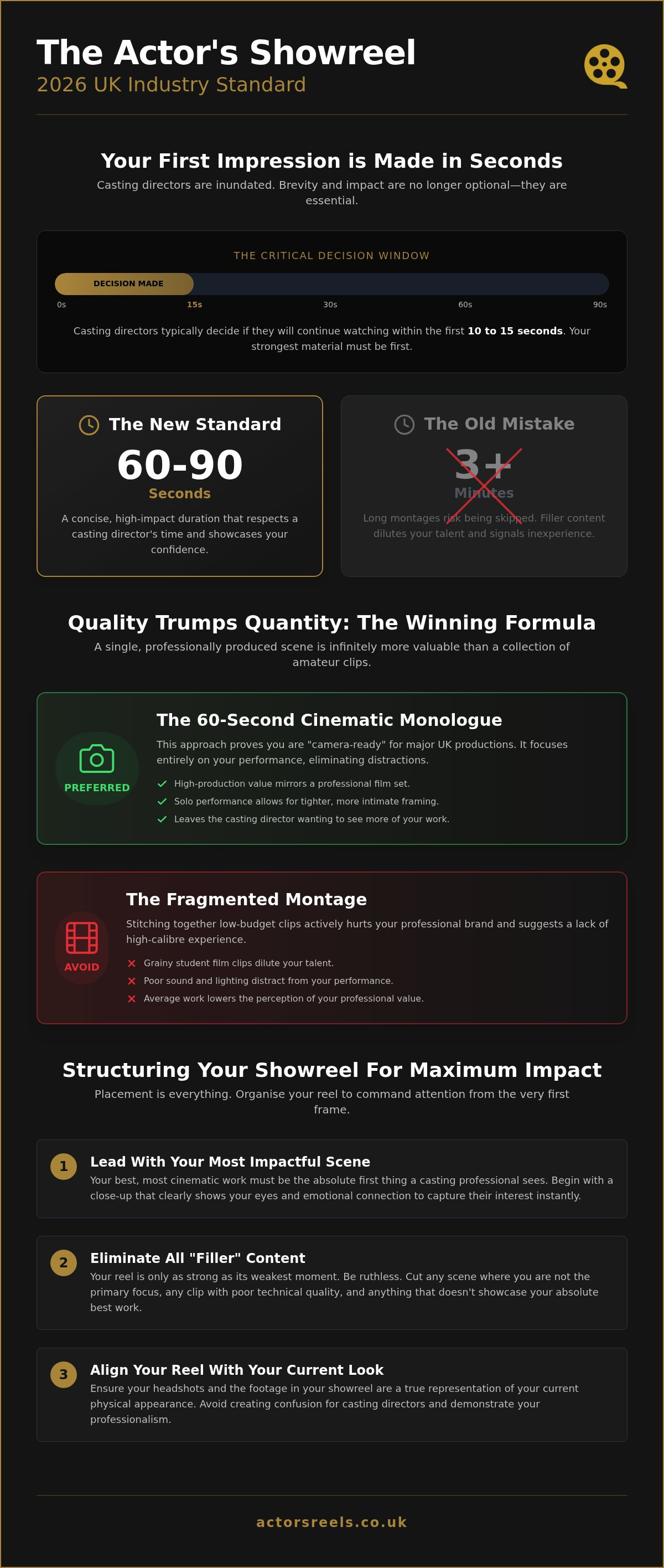
The industry has shifted. The days of the three-minute montage are over. If you are wondering how long should an acting showreel be to remain competitive, the definitive answer for 2026 is 60 to 90 seconds. This duration respects the time of busy casting professionals whilst ensuring your strongest material isn't buried under filler. Before diving into the technicalities, it's helpful to understand What is a Showreel? and how its purpose has evolved. It is no longer a career history; it is a high-impact sales tool designed to secure your next audition.
The Showreel Sweet Spot is the intersection of high-impact acting and concise editing. Anything over two minutes risks being skipped entirely due to industry fatigue. Casting directors are processing hundreds of tapes daily. They need to see your "camera-ready" quality immediately. Shorter reels demonstrate professional confidence and an understanding of modern production standards. It shows you value their time as much as your own craft.
The "10-Second Rule" and Why It Matters
Casting directors often decide within the first 10 to 15 seconds if they want to see more. You cannot afford to "warm up" or include long, atmospheric intros with moody music. Your best, most cinematic work must appear immediately. Start with a close-up that clearly shows your eyes and your emotional connection to the script. Demand attention from the first frame. If the first ten seconds don't land, the remaining eighty seconds will likely never be seen. Efficiency is your greatest asset in a digital-first casting environment.
Spotlight Showreel Requirements for 2026
Whilst the platform allows for larger uploads, meeting the technical Spotlight showreel requirements is only half the battle. You must ensure your file sizes and formats are optimised for instant playback. However, technical compliance does not guarantee engagement. A file that is technically perfect but bloated with irrelevant footage will still fail to convert. Focus on high-end production values that mimic a real film set. This approach proves you belong on a professional production before you even step into the room.
Quality Over Quantity: Why the 60-Second Cinematic Monologue Wins
Many actors fall into the "Montage Trap". They stitch together fragmented clips from low-budget student films or grainy background work. This approach actively hurts your brand. It signals to industry gatekeepers that you aren't yet working at a professional level. In contrast, a single, high-production-value monologue proves you are camera-ready for major UK productions. It eliminates the distraction of poor lighting and amateur sound design. When deciding how long should an acting showreel be, remember that brevity creates intrigue. A shorter reel is easier to share via email or WhatsApp and loads faster on mobile devices. Most importantly, it leaves the viewer wanting more. You want the casting director to ask for your full portfolio, not look for the exit button.
Understanding the power of cinematic monologue reels for actors in 2026 is the most efficient way to build a portfolio from scratch. You don't need to wait for a lead role in a feature film to show what you can do. You can take control of your career by creating your own opportunities. If you want to ensure your footage meets these high-end standards, consider booking a session for a cinematic monologue showreel that captures your specific range with precision.
Avoiding "Filler" Content
Never include "unseen" characters or scenes where you are not the primary focus. Every second you are not on screen is a wasted second. The psychological impact of including one great scene is far stronger than including three average ones. Average work dilutes your talent. It lowers the perception of your professional value. If a clip doesn't showcase your absolute best work, cut it. Your reel is only as strong as its weakest moment.
The Solo Benefit: Filming Without a Partner
Solo monologues allow for tighter framing. We can focus entirely on your facial expressions and emotional nuances without the distraction of a scene partner. Casting directors prefer seeing your internal reaction over a wide shot of two people talking. It provides the clarity they need to make a fast casting decision. This specialised focus ensures that 100% of the screen time is dedicated to your performance, making the most of every second.
Structuring Your Showreel for Maximum Impact
Placement is everything. Start with your strongest performance. Do not save your best work for the finale. Casting directors may never reach the end if the opening doesn't hook them. Forget about the "prestige" of the project or the size of the production. If your most compelling, nuanced acting is in a sixty-second monologue, put it front and centre. When determining how long should an acting showreel be, remember that a perfectly structured 60-second reel beats a poorly ordered three-minute one every time.
Visual consistency is vital. Ensure your headshot matches your current look on the reel. If you've changed your hair colour or style since filming, you risk confusing casting professionals. Keep transitions simple. Avoid flashy wipes, distracting text overlays, or loud music that competes with your voice. The focus must remain entirely on your performance. Close with a clear "End Card" featuring your name, agent, and contact details. Keep this on screen for no more than five seconds.
The Professional Edge: Studio vs. Home Recording
Lighting and sound quality are non-negotiable. A home recording often suffers from flat lighting and echoey audio, which instantly screams "amateur". Professional studio environments provide controlled conditions that mimic a high-end film set. Learning how to get a professional actor showreel through a dedicated studio allows you to bypass years of waiting for footage from slow-moving productions. It puts you in the director's chair of your own career.
Final Checklist Before You Export
Review your edit with a critical eye. Check for audio consistency between scenes; sudden jumps in volume are jarring. Ensure there are no distracting background noises like traffic or humming appliances. Finally, verify that your most recent work is the first thing they see. Your reel should reflect who you are as an artist today, not who you were three years ago. High-end production value is the standard. Don't settle for less.
Take Control of Your Casting Future
The landscape for UK actors in 2026 demands efficiency. You now know that how long should an acting showreel be is less about total minutes and more about high-impact seconds. A tight, sixty to ninety-second reel ensures your talent is seen before a casting director moves to the next candidate. By prioritising cinematic monologues over fragmented student clips, you position yourself as a camera-ready professional. Lead with your strongest work and keep your technical presentation flawless to command respect in the audition room.
Don't wait for the industry to give you footage. Take charge of your career with Actors Reels, your professional studio partner. We specialise in cinematic studio production and offer high-end monologue packages for actors that deliver national-level quality. It's time to replace your dated montage with a portfolio that reflects your true range. Book your cinematic monologue showreel session today and give yourself the professional edge you deserve. Your next big role is waiting for a reel that finally matches your ambition.
Frequently Asked Questions
Is a 1-minute showreel too short for a professional actor?
Absolutely not. In 2026, a sixty-second reel is often the sweet spot for busy casting professionals. Quality always trumps quantity. If you can prove your range and screen presence in one minute, you've done your job. It's much better to have one minute of broadcast-quality footage than three minutes of student film scenes that dilute your professional image.
Do casting directors watch the entire showreel?
Rarely. Most industry gatekeepers decide whether to keep watching within the first ten to fifteen seconds. If you don't hook them immediately, they'll click away. This is why the question of how long should an acting showreel be is secondary to how strong your opening scene is. They only watch the full duration if the initial performance is undeniable.
What should I do if I don’t have enough footage for a 2-minute reel?
You shouldn't aim for two minutes if the material isn't there. Forcing length with sub-par clips is a mistake that leads to being ignored. Instead, invest in a single, high-end cinematic monologue. This provides a focused, professional look that proves you're ready for a major set. It solves the problem of how long should an acting showreel be by focusing on impact over duration.
Can I include a monologue I filmed at home in my professional showreel?
It's risky. Casting directors expect a certain level of technical precision that home setups rarely achieve. Poor lighting and echoey audio act as a distraction from your performance. If your goal is to stand out amongst a sea of talent, your footage must mirror the visual standards of a professional production house. A studio-filmed monologue ensures you're taken seriously from the first frame.


