

Your first showreel shouldn't be a collection of your past work. It's a strategic showcase of your future potential. For most newcomers, the biggest hurdle isn't a lack of talent. It's a lack of high-end footage that matches the visual standards of the BBC or Netflix. These first acting showreel tips will help you move past the amateur label. You don't need a decade of credits to look like a professional. You need one high-impact, cinematic moment. High production value. Professional standards. Absolute clarity.
We understand the frustration of having no professional footage whilst fearing a DIY setup will stall your career. It's easy to feel lost amongst conflicting advice on reel length and content. This guide provides the clarity you need to launch your career with confidence. You'll learn how to master the 2026 benchmarks for 4K production, why the industry has shifted from montages to monologues, and how to ensure casting directors see your true potential within those critical first 15 seconds of viewing.
Key Takeaways
- Treat your showreel as a digital calling card that prioritises your current screen presence over a list of past credits.
- Master essential first acting showreel tips by identifying your specific "casting bracket" to ensure your material aligns with industry perceptions.
- Select nuanced, naturalistic scripts that allow for a grounded, believable performance rather than relying on high melodrama.
- Prioritise cinematic production values to ensure your audio and lighting meet the high-end standards expected by top-tier casting directors.
- Understand why a single, high-impact monologue in a controlled studio environment often outshines a fragmented montage of amateur clips.
Understanding the Purpose of Your First Acting Showreel
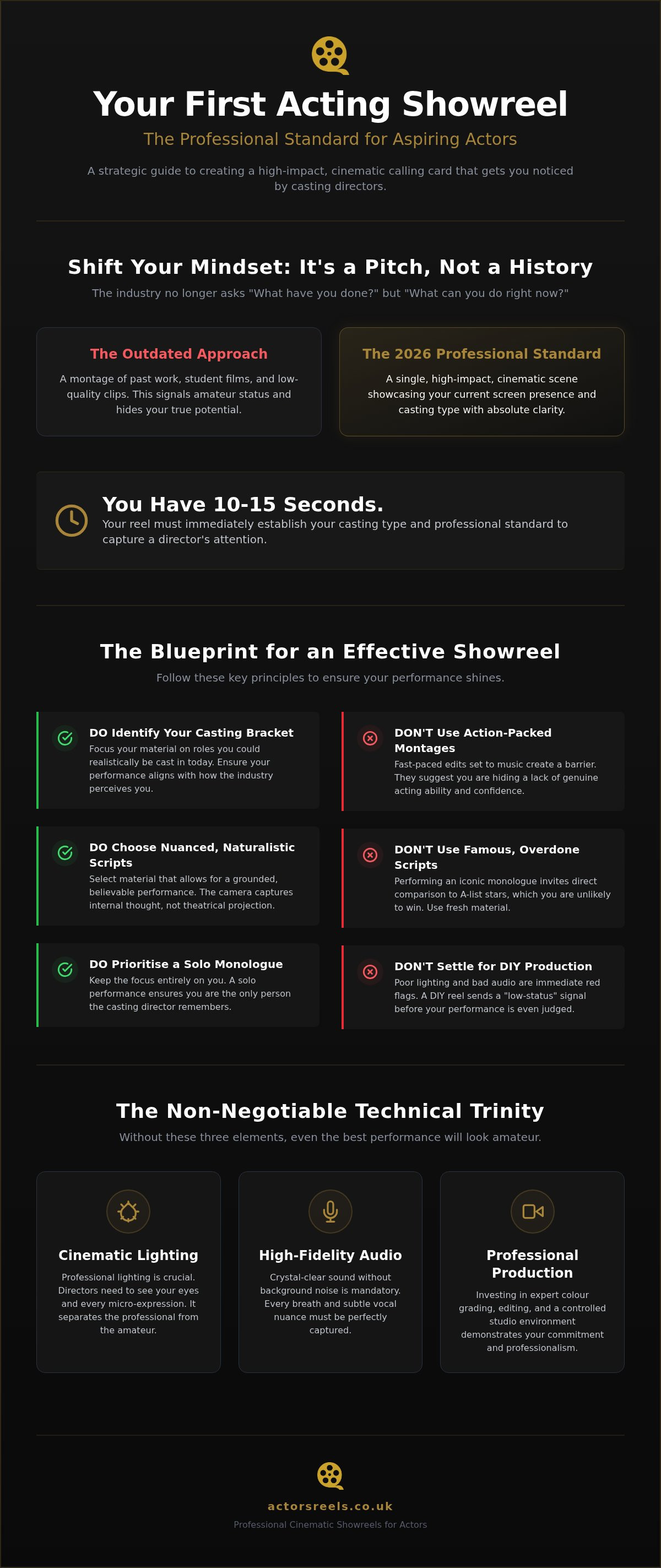
Your showreel is your digital calling card. It is the primary tool casting directors use to verify your screen presence before they ever consider an audition invitation. In 2026, the industry has shifted its focus. It no longer asks "what have you done?" but rather "what can you do right now?" This distinction is vital for newcomers searching for first acting showreel tips. You aren't building a museum of past achievements. You're creating a high-end pitch for your next professional role.
Efficiency is everything. You have approximately ten seconds to capture attention. Your first reel must establish your casting type immediately to be effective. If a director cannot place you in a specific "bracket" within that first window, the opportunity is lost. Current Spotlight showreel requirements reflect this need for clarity. They now prioritise clear audio and professional lighting above all else. Without these technical foundations, even the best performance will look amateur.
What Casting Directors Actually Want in 2026
Authenticity is the most valuable currency in modern casting. Directors want to see the real you. They don't want characters hidden behind heavy makeup, distracting costumes, or theatrical artifice. They need to see your eyes. They need to hear the subtle nuances of your performance. Every breath and every micro-expression must be visible. This level of clarity requires a controlled studio environment where background noise and poor lighting don't mask your talent.
The Myth of the "Action-Packed" Montage
New actors often feel pressured to create fast-paced montages set to dramatic music. They believe this creates energy. In reality, it creates a barrier. It hides the acting. One of the most critical first acting showreel tips is to avoid these frantic edits. They suggest you're hiding a lack of ability. Instead, embrace the power of the "quiet moment". A still, focused performance demonstrates a level of confidence and screen presence that a montage simply cannot replicate. It proves you can hold the frame and command the viewer's attention without gimmicks.
Selecting and Preparing Material for Maximum Impact
Selecting the right material is a strategic exercise. It begins with identifying your "casting bracket". Ask peers and mentors how they perceive your energy on screen. Are you the corporate lead or the gritty underdog? Knowing this prevents you from wasting time on roles that don't fit your current look. One of the best first acting showreel tips is to stay realistic. Source or commission a script that allows for a nuanced, naturalistic performance. High melodrama often feels forced in a reel. It's about being, not acting. Ensure the material reflects roles you could realistically be cast in today.
Precision matters. Once you have your script, rehearse specifically for the lens. You must eliminate theatrical projection. The camera is inches away, not at the back of a theatre. Focus on internal thought processes. The lens captures the flicker of a thought in your eyes. This internal work creates the "cinematic" quality that casting directors crave. It shows you understand the medium and possess the discipline required for professional sets.
Choosing the Right Monologue for Your Casting Type
Avoid over-exposed scripts from famous films. Casting directors have seen the same iconic monologues a thousand times. It invites unwanted comparison to A-list stars. Instead, focus on a solo monologue showreel to keep the spotlight entirely on your performance. This ensures you aren't sharing the frame or the focus with another actor. Your goal is to be the only person they remember when the clip ends.
Rehearsal Techniques for the Camera
Practice stillness. Grand gestures often look chaotic on a small screen. The camera magnifies every movement. Record your rehearsals on a phone to check for distracting physical habits like excessive blinking or swaying. Review the footage objectively. If you want to ensure your performance is captured with professional precision, consider working with an expert production partner to elevate your final product. This allows you to focus on the craft whilst we handle the technical execution.
Investing in Professional Cinematic Production
A DIY reel often does more harm than good. It sends a "low-status" signal to agents and casting directors, suggesting a lack of professional standards. In a competitive industry, your visual presentation must match your talent. Cinematic production involves deliberate lighting, expert colour grading, and high-fidelity sound. These are technical elements a smartphone simply cannot replicate. If your footage looks amateur, the industry will assume your acting is too.
Securing actor showreel production positions you as a serious contender. It's a strategic investment in your career advancement. High production value tells the room you're ready for a professional set. Amongst the noise of thousands of applicants, quality is your loudest advocate. This is one of the most vital first acting showreel tips: don't let poor technical execution distract from your performance. Studio-based filming provides a controlled environment, ensuring your screen presence remains the absolute focus.
Why Cinematic Quality is Non-Negotiable
High production value has a profound psychological impact. It bypasses the "amateur" filter in a casting director's mind. Professional lighting creates the visual depth required for a high-end, filmic look. It separates you from the background and draws the eye to your performance. It highlights the micro-expressions that tell the story. Without this level of technical precision, even the most nuanced performance loses its impact on a small screen.
The Strategic Advantage of Studio-Based Monologues
Filming in a professional studio beats location filming for your first reel. You gain total control. No sirens. No wind noise. No unpredictable lighting. This consistency allows you to build your acting portfolio from scratch. You don't need to wait for student film directors to send you fragmented clips. You take charge of your narrative. You create the exact footage you need to prove your range and launch your professional acting career with confidence.
Launch Your Professional Screen Career
Success in the 2026 casting landscape requires more than just raw talent. It requires a strategic presentation that aligns with high-end industry standards. By identifying your casting bracket and selecting nuanced material, you move from being an aspiring actor to a professional contender. These first acting showreel tips provide the blueprint for a reel that demands attention rather than just requesting it. Prioritise clarity, embrace stillness, and ensure your technical quality matches your artistic vision.
You don't need to wait for a breakout role to secure professional footage. Actors Reels specialises in cinematic monologue production within a professional studio environment. Our service is specifically designed for actors without existing footage who need to showcase their screen presence immediately. We provide the technical precision and creative direction necessary to capture your best performance in a controlled, filmic setting.
Book your cinematic monologue session with Actors Reels today and take control of your narrative. Your career doesn't start when someone else gives you a chance. It starts when you decide to be ready for it. We look forward to seeing you on set.
Frequently Asked Questions
How long should my first acting showreel be?
Aim for a total duration between 60 and 120 seconds. Casting directors often make a decision on your suitability within the first 15 to 30 seconds, so lead with your strongest material. A concise, high-impact reel ensures you don't lose their attention with unnecessary filler. Focus on delivering maximum impact in minimum time. Quality always trumps quantity.
Can I use a monologue for my first showreel if I have no other footage?
Yes, a cinematic monologue is the most strategic choice if you lack professional screen credits. The industry has moved away from fragmented montages towards singular, high-impact performances. One of the best first acting showreel tips is to use a studio-based monologue to demonstrate your screen presence. This avoids the distractions often found in low-quality student film clips or amateur footage.
Is it better to have a short professional reel or a long amateur one?
A short professional reel is always superior to a long amateur one. Technical standards are non-negotiable in 2026. Poor audio or lighting sends a "low-status" signal to top-tier agents and casting directors. A 60-second clip with cinematic production values positions you as a serious professional, whilst a five-minute amateur reel can actively damage your reputation before you even enter the room.
What should I wear for my showreel filming session?
Choose simple, solid colours that complement your skin tone and don't distract from your face. Avoid busy patterns, large logos, or noisy jewellery that might interfere with the microphone. Your clothing should subtly suggest your casting type without feeling like a theatrical costume. Keep the focus entirely on your performance and your eyes. This ensures the viewer stays connected to your acting.
Do I need a professional showreel to get an agent in the UK?
A professional showreel is a critical requirement for securing representation in the UK. It serves as your 24/7 digital audition. Most agents won't consider a new client without seeing proof of their screen presence and technical suitability. High-end production value ensures your submission meets the rigorous standards expected by the industry's leading agencies. It proves you are ready for professional sets.
How often should I update my showreel as a new actor?
Update your reel whenever your physical appearance changes significantly or when you acquire higher-quality footage. If you change your hair colour or age out of a specific casting bracket, your reel must reflect your current look. Keeping your material fresh ensures that casting directors see exactly who will walk through the door. Regular updates demonstrate that you are an active, working professional.


