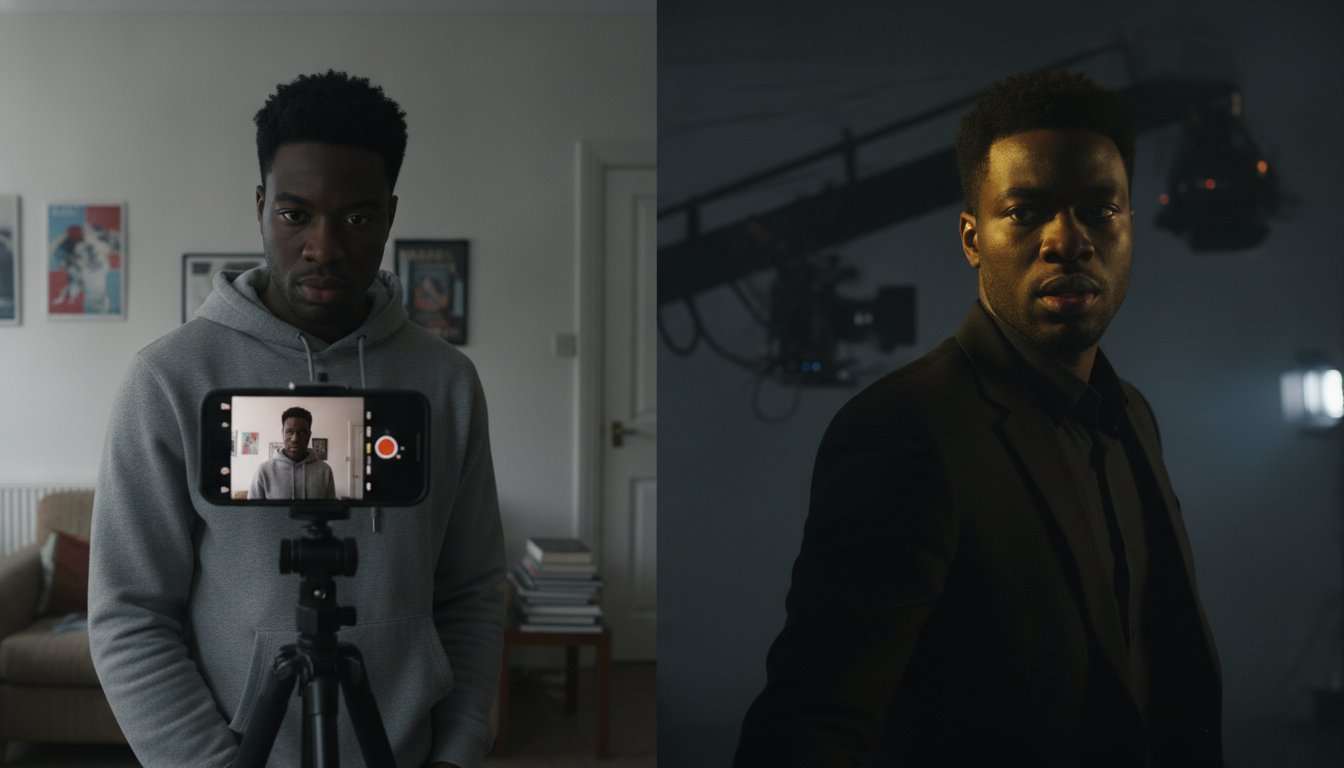
Your first showreel isn't a career retrospective; it's a 90-second cinematic audition. It either secures the meeting or ends the conversation. Most emerging actors struggle with the "no footage" paradox, fearing that a lack of professional broadcast credits will make them look like an amateur. This anxiety often leads to common acting showreel mistakes that instantly signal a lack of industry experience to casting directors and agents.
It's a frustrating position to be in, but professional success is a direct result of high-quality preparation. You deserve a reel that reflects your artistic vision, not your technical limitations. Discover the critical errors that prevent decision-makers from watching your footage and learn how to present your talent with cinematic precision. We'll explore everything from the ideal length and format to the impact of studio-based production value. This is your clear path to a reel that actually works for your career.
Key Takeaways
- Learn why your face must be the first frame a casting director sees to ensure you make an immediate, professional impact.
- Identify the acting showreel mistakes that lead to the "montage trap" and learn why music-led intros are a waste of time in 2026.
- Discover why studio-grade audio and cinematic lighting are essential for bypassing the "amateur" filter of top-tier agents.
- Solve the "no footage" problem by using cinematic monologues to bridge the gap between training and professional work.
- Understand why a single, high-production solo scene is more effective for your career than a collection of low-budget student film clips.
The Strategic Mistakes of Your First Acting Showreel
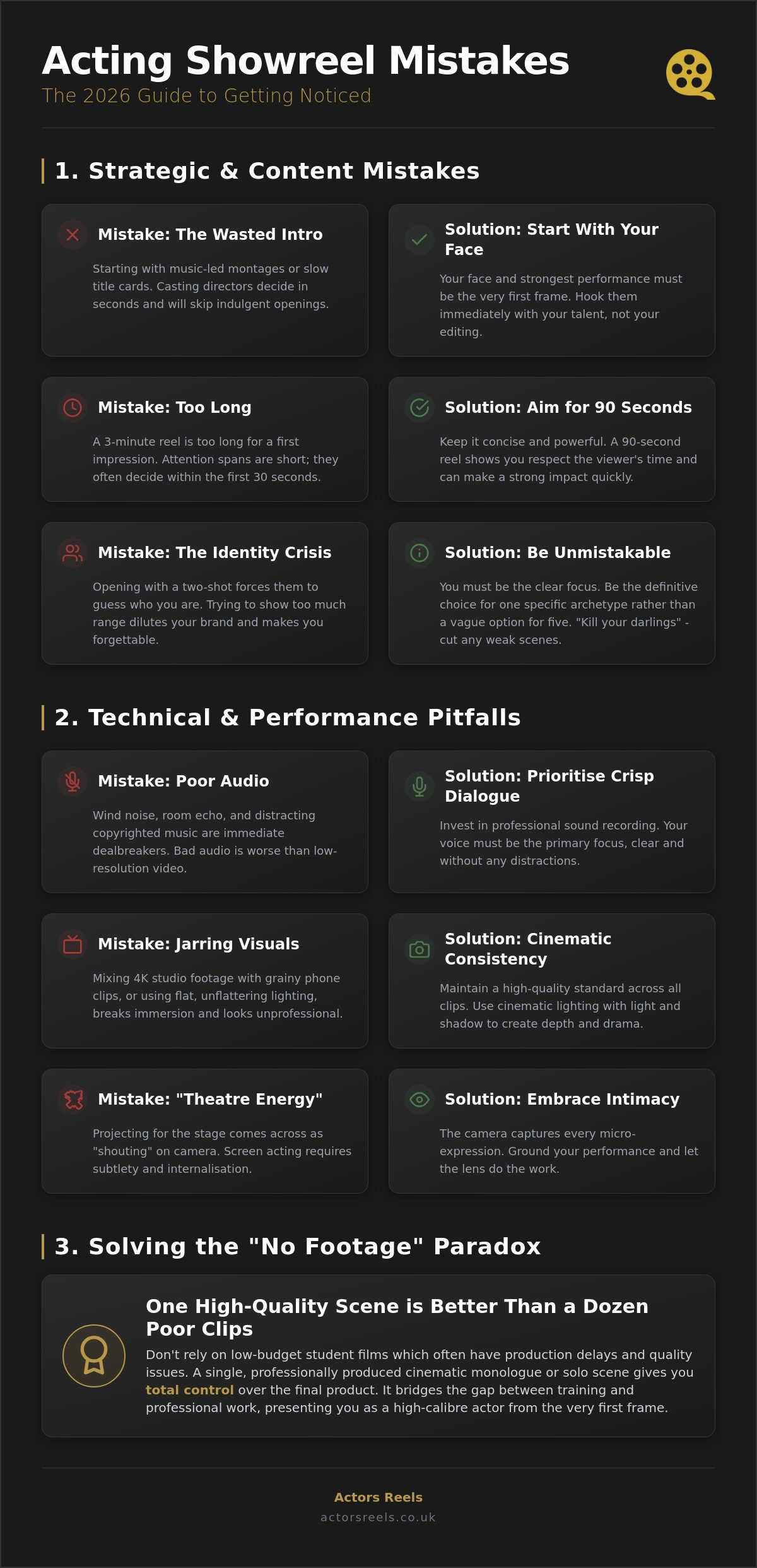
A casting director’s time is their most valuable currency. Don't waste it. If you spend the first ten seconds of your reel on a music-led montage or a slow-fading title card, you've already lost. This is one of the most common acting showreel mistakes. In 2026, the industry standard has shifted away from stylistic fluff. Your face must be the first thing they see. No montages. No mood music. Start with your strongest performance immediately. Avoiding these acting showreel mistakes ensures your talent remains the focus, not your editing choices.
Many actors fall into the "Diversity Fallacy". They attempt to prove they can play everything from Shakespearean royalty to a gritty detective in under two minutes. This results in a diluted brand. You aren't showing range; you're showing a lack of focus. It's better to be the definitive choice for one specific archetype than a forgettable option for five. Failing to "kill your darlings" is equally fatal. One mediocre student film clip with poor sound or wooden dialogue will drag down three brilliant, high-end scenes. If a clip isn't exceptional, cut it.
The Identity Crisis: Who Are You Casting?
Never open with a two-shot. If you start your reel with a scene featuring another actor who shares your physical "type", you force the casting director to guess which one is you. They won't guess; they'll skip. It's a common pitfall that ignores the primary purpose of the reel. Ensure your current look matches the footage. If you've changed your hair colour or style since filming, the disconnect creates immediate friction. Your reel must confirm your headshot, not contradict it.
Length and Pacing: Why Less is Always More
Attention spans are shorter than ever. The 90-second benchmark is your target. Whilst some outdated advice suggests three minutes, the reality is that decision-makers usually decide within thirty seconds. Your first acting showreel shouldn't exceed two minutes. Precision beats volume every time. For a deeper dive into timing, learn how long should an actor showreel be? to ensure your pacing matches professional industry standards.
Technical and Performance Pitfalls to Avoid
Technical polish isn't a luxury. It's a professional requirement. Mixing 4K studio footage with grainy phone clips is one of the most jarring acting showreel mistakes. It breaks the viewer's immersion immediately. It signals that you haven't yet committed to a consistent professional standard. Similarly, never include background artist work or "walk-on" roles to fill space. Casting directors want to see you act; they don't want to play "Where's Wally?" whilst you stand in the back of a crowded scene. If you aren't the focus, the footage doesn't belong on your reel.
The Sound of Silence (and Bad Audio)
Audio is the invisible dealbreaker. If an agent hears wind noise or a hollow "room echo" from a poorly recorded self-tape, they'll skip your reel within seconds. Clear, crisp dialogue is far more important than visual resolution. You should also avoid using copyrighted music. It's a distraction that competes with your vocal performance and often leads to copyright flags on casting platforms. Your voice must be the only thing they focus on.
Performance Choices: Stage vs. Screen
Stage acting requires projection to reach the back of the gods. Screen acting requires internalisation. Bringing "theatre energy" to a cinematic reel is a frequent error highlighted amongst common showreel mistakes. The camera is intimate; it sees every micro-expression. A raised eyebrow on stage is a grand gesture, but on screen, it's a shout. You must understand what to include in a monologue showreel to ensure your performance remains grounded and subtle.
Lighting and focus are equally critical. Don't confuse "bright" with "cinematically lit". Flat, overhead lighting kills the drama and makes your skin tones look washed out. Professional production uses light and shadow to create depth, ensuring you are the undeniable centre of the frame. This level of technical precision is why many actors now opt for a cinematic monologue showreel to ensure their first impression is flawless and high-end.
Building a Professional Showreel Without Existing Credits
The "no footage" paradox often traps talented actors in a cycle of unemployment. You need professional clips to get the job, but you need the job to get the clips. Relying on student films or low-budget shorts to build your foundation is one of the riskiest acting showreel mistakes. These projects frequently suffer from production delays, poor colour grading, or sound issues that render the footage unusable. Instead, a studio-controlled environment allows you to bypass these variables. You gain total control over the narrative, the lighting, and the final edit.
A single, high-quality solo scene carries more weight than five disjointed clips of varying quality. When comparing solo reels vs montages, the industry preference in 2026 is clear: casting directors want to see your ability to hold a frame. This approach eliminates the distraction of external factors and keeps the focus entirely on your performance. It's about demonstrating that you are a safe bet for a professional production.
The Power of the Cinematic Monologue
A cinematic monologue isn't just a recording of a speech; it's a high-end production designed to replicate the aesthetic of premium TV and film. This format has become the standard for an actor showreel without a scene partner. It demonstrates your technical proficiency and your ability to work within a professional frame. By avoiding common showreel mistakes like theatrical over-acting, you prove you are ready for a professional set.
Investing in Your Professional Brand
Your reel is a results-driven business investment. It's the primary tool that secures your representation and your auditions. Beyond the main reel, using social media promo clips is a strategic way to expand your reach amongst UK casting directors. These bite-sized assets allow you to stay visible on platforms like Instagram and TikTok whilst maintaining a high-end brand identity. Professional success isn't a luxury; it's the direct result of high-quality preparation and a refusal to settle for amateur standards.
Command the Attention of Casting Directors
Your showreel is the most powerful marketing tool in your arsenal. It must be precise, professional, and undeniably cinematic. By prioritising high production value and technical clarity, you eliminate the distractions that lead to common acting showreel mistakes. A single, expertly produced solo scene is far more effective than a collection of low-quality clips that dilute your brand. Your goal is to prove you belong on a professional set before you even walk through the door.
Success in this industry isn't a matter of luck; it's a result of meticulous preparation. Focus on what you can control: your performance, your sound quality, and your visual brand. When you present yourself with cinematic precision, you shift the narrative from aspiring talent to seasoned professional. It's time to stop waiting for the perfect role and start creating the perfect footage.
Ready to bridge the gap between training and your first major credit? Book your cinematic monologue showreel with Actors Reels today. Our service provides professional studio-based filming with cinematic post-production included as standard. We offer a competitively priced UK-wide service designed to propel your career advancement. Your talent deserves a platform that matches your ambition.
Frequently Asked Questions
Can I include self-tapes in my first acting showreel?
You can include self-tapes only if they meet professional broadcast standards for audio and lighting. Relying on average home recordings is one of the most common acting showreel mistakes that can signal a lack of industry experience. If your tape features distracting background noise or flat lighting, it will undermine your talent. Only use self-tapes that look and sound like a finished production to ensure you maintain a high-end professional brand.
How many scenes should be in a 2-minute showreel?
Aim for two or three high-impact scenes that allow your performance to breathe. Packing too many short clips into a two-minute window prevents casting directors from seeing your ability to sustain a character. Each segment should last roughly 30 to 45 seconds. This structure provides enough depth to showcase your range whilst ensuring the viewer stays engaged from the first frame to the final cut.
Is it a mistake to use a monologue I wrote myself?
Using a self-written monologue is risky unless the writing is indistinguishable from a professional script. Casting directors have an ear for dialogue; if the script feels amateur, it reflects poorly on your acting ability. It's usually better to use established material or a professionally written monologue tailored to your casting type. This keeps the focus on your performance rather than highlighting a lack of screenwriting experience.
Should I include my headshot at the start or end of the reel?
Place your headshot and contact details at the end of the reel to ensure your performance starts immediately. Opening with a static image or a title card is one of the acting showreel mistakes that wastes the viewer's time. You have mere seconds to grab a casting director's attention. Start with your strongest footage and save the formal identification for the final frame once you've already made a lasting impression.