
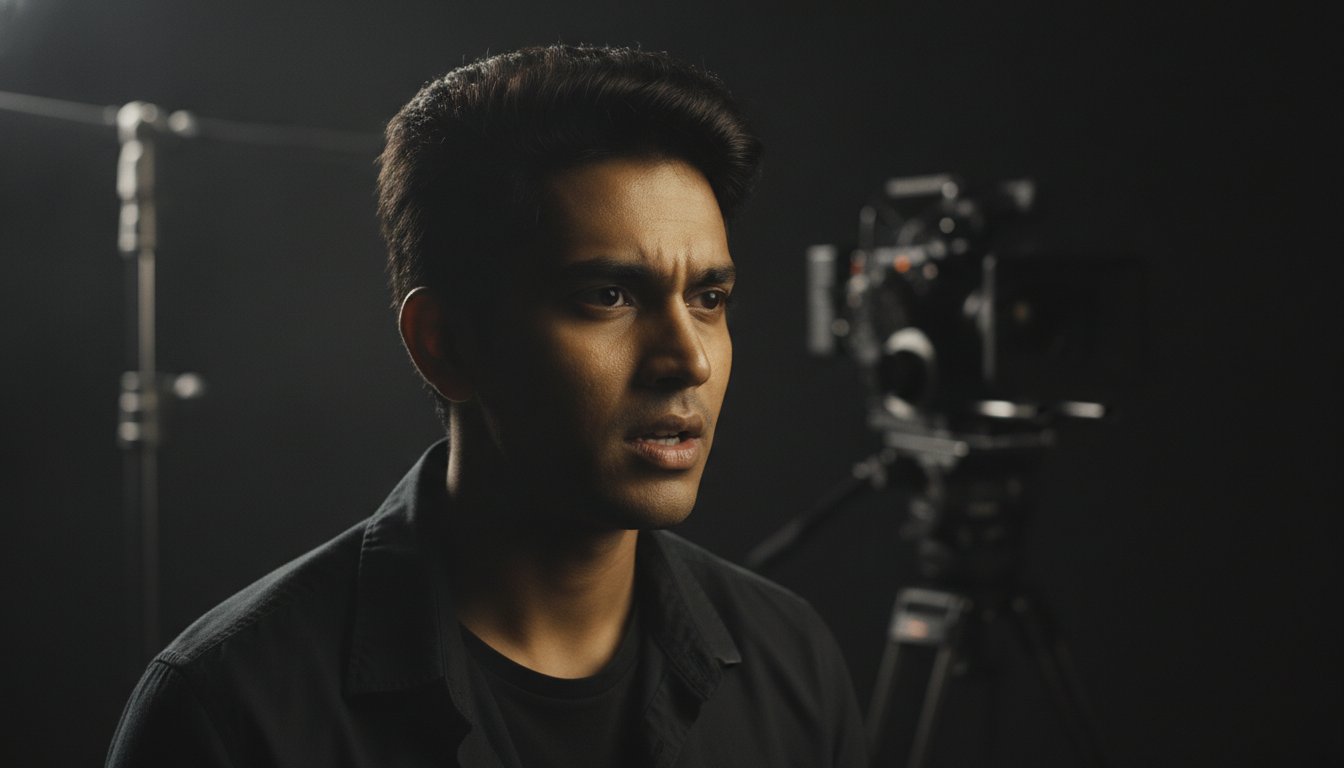
A casting director will decide the trajectory of your career in less than fifteen seconds. If you're relying on grainy footage or shaky rehearsal clips, you're likely being dismissed before you've even finished your first line. It's a common hurdle for new graduates. You've spent years perfecting your craft, but your current student actor showreel probably feels like a series of compromises rather than a professional calling card.
We agree that your talent deserves better than sub-par production values. This guide provides the blueprint for transitioning from drama school to professional sets with a cinematic reel that captures your specific screen presence. We'll break down the latest 2026 industry standards, the power of high-impact monologues, and how to build a portfolio that secures agent meetings without needing a blockbuster budget. It's time to stop settling for "good enough" and start presenting yourself as the professional you already are.
Key Takeaways
- Understand why your graduate reel is the vital bridge between drama school training and securing a reputable UK agent.
- Discover why a professionally produced monologue is more effective for a student actor showreel than a montage of low-quality student film clips.
- Learn the technical production standards, from lighting to colour grading, that command immediate attention from casting directors.
- Master a streamlined preparation process to ensure you are fully off-book and ready to deliver a high-impact performance under studio conditions.
- Identify how cinematic monologue packages provide the professional edge needed to compete in the 2026 industry landscape.
Launching Your Career: The Essential Student Actor Showreel
The transition from drama school to the professional circuit is often the most vulnerable period in an actor's career. You've spent years refining your voice and movement. Now, you need a tool that translates that training into a format agents and casting directors can use. A high-quality student actor showreel acts as your digital handshake. It’s the difference between being perceived as a trainee and being seen as a professional peer. In the 2026 digital-first casting landscape, your reel is your primary currency. It is the first thing a casting director clicks after viewing your headshot. If it doesn't look professional, they won't even press play.
For those wondering exactly what is a showreel?, it is a short video showcasing an actor's best work to potential employers. In the UK market, this is your most powerful asset for career advancement.
The Drama School Transition
Archival theatre footage rarely serves your screen career. The projection required for a 500-seat auditorium often looks like overacting when captured by a high-definition camera lens. Casting directors need to see the subtlety of your eyes and the internal life of your character. They want to see how you handle the intimacy of the frame. Establishing your professional brand before your final showcase gives you a vital head start. Don't wait for your school to provide clips that might never materialise. Most student films lack the lighting and sound quality required for a professional portfolio. Take control of your narrative by producing material that mirrors the standards of the sets you want to work on.
Spotlight Requirements for Graduates
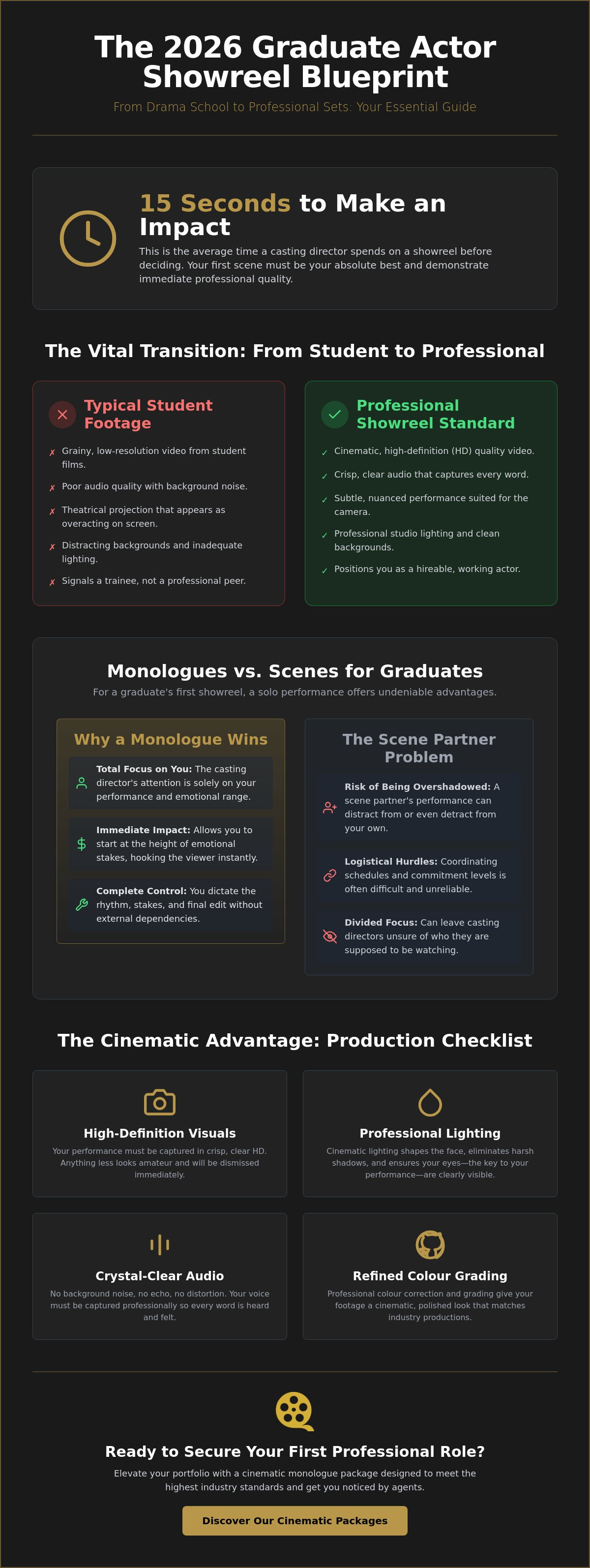
Spotlight remains the industry standard in the United Kingdom. To build a profile that commands respect, you need more than just a headshot. A professional reel is often the deciding factor for agents deciding whether to sign a new graduate. Keep it concise. Industry standards for 2026 suggest a total length of 2 to 3 minutes. However, your best work must appear in the first 15 seconds. Ensure the format is high-definition and the sound is crisp. Casting directors have no patience for poor audio or cluttered backgrounds. They want a clear, unobstructed view of your face and a direct connection to your performance. A clean, studio-shot reel ensures that the focus remains entirely on your ability, not the technical shortcomings of the production.
Adopting these standards early signals that you understand the business of acting. It moves you beyond the "student" label. You aren't just a graduate; you're a working professional with the materials to prove it. Professional success is a direct result of high-quality preparation. Start now.
Monologues vs Scenes: Why Solo Performances Win for Graduates
There is a persistent myth in drama schools that you need a multi-actor scene to prove you can act. It's incorrect. For a student actor showreel, the objective isn't to show you can play well with others; it's to show you can carry the screen. Casting directors are time-poor. They want to see your face, your reactions, and your emotional truth immediately. A sixty-second monologue often provides more clarity than a three-minute scene cluttered with exposition and secondary characters. You are the product. Keep the focus on you.
Efficiency is the new industry standard. Research indicates that many casting directors will turn off a reel if they aren't impressed within the first fifteen seconds. Scenes often require a slow build-up or narrative context that you simply don't have time for. A monologue allows you to open on a hook. You can start the scene at the height of the emotional stakes. This immediate impact is what secures the "yes" in a competitive 2026 market.
The Scene Partner Problem
Relying on others for your professional portfolio is a significant risk. Finding reliable scene partners for student-led projects is notoriously difficult. Schedules clash. Commitment levels vary. Even if you find a partner, you risk being overshadowed or, worse, dragged down by a wooden performance. If your partner is overacting, it distracts the viewer from your subtlety. By choosing a solo performance, you eliminate these variables. You maintain total control over the rhythm, the emotional stakes, and the final edit. Every frame serves your career, not someone else's. It ensures the casting director isn't left wondering which person they are supposed to be watching.
Focusing on Your Essence
Selecting your own material allows you to define your brand with precision. You choose the script that aligns with your specific casting type and physical strengths. Whether it's a gritty contemporary drama or a sharp comedic piece, the narrative is yours to command. You can demonstrate significant emotional depth in a very short window without needing to explain a complex relationship with an off-screen character. This level of preparation shows initiative and professional maturity. If you're ready to define your screen presence, a Cinematic Monologue Showreel ensures you remain the undeniable centre of attention. You aren't just an actor in a scene; you are the lead in your own professional story.
The Cinematic Advantage: Defining High-End Production Standards
Production quality isn't a luxury. It's a professional necessity. A student actor showreel that looks like a high-budget film immediately distinguishes you from the thousands of graduates using grainy, poorly lit student film footage. Cinematic quality is defined by technical precision. It involves deliberate lighting, professional colour grading, and purposeful composition. When a casting director sees high production value, they subconsciously associate that quality with your talent. It’s a psychological shortcut that positions you as a professional ready for a major set. High-end visuals signal that you understand the standards of the industry you're trying to enter.
Avoiding the "student film look" is essential for career advancement. Amateur footage often suffers from flat lighting and muddy colours. It looks unfinished. By opting for a controlled studio environment, you eliminate the variables that ruin location shoots. You don't have to worry about the sun disappearing or a siren interrupting your best take. Studio-based filming allows for a level of consistency that's impossible to achieve on a student-led project. It ensures that the final product is polished, professional, and ready for agent submissions.
Lighting and Composition for Screen
Three-point lighting is the industry standard for a reason. It creates depth. It carves the actor out from the background and ensures your facial expressions are captured with absolute clarity. In a cinematic reel, the close-up is your most effective tool. It forces the viewer to connect with your internal life. Every frame should be composed to complement the script's mood without distracting from your performance. Professional composition ensures the frame feels balanced and intentional. It shows you know how to work with the camera, not just in front of it.
Audio Quality: The Unsung Hero
Poor audio is the fastest way to kill a career opportunity. If a casting director has to strain to hear your dialogue, they'll stop watching. It's that simple. Studio acoustics provide a pristine environment where every vocal nuance is preserved. You don't get wind noise or muffled dialogue from a poorly placed boom mic. High-end audio ensures your performance feels intimate and grounded. It captures the breath, the pauses, and the subtle shifts in tone that define a great performance. Professional sound isn't just about volume; it's about clarity and emotional resonance. It's the difference between a recording and a performance.
Preparing for Success: A Step-by-Step Guide to Your Studio Shoot
Preparation is the foundation of a high-end performance. A student actor showreel succeeds when the actor treats the studio day like a professional contract. You're likely balancing final-year showcases and intense drama school commitments, but this shoot requires absolute focus. Arrive ready. Being 100% off-book is non-negotiable. If you're struggling with lines, you cannot respond to direction or adjust your performance rhythm. The camera captures every flicker of doubt in your eyes. Memorise the script until it's muscle memory. This freedom allows you to inhabit the character and take risks that a less-prepared actor wouldn't dare. Professionalism starts with your work ethic before the camera even rolls.
Script Selection for Students
Finding the right material is a strategic decision rather than an artistic one. Avoid the "audition staples" that casting directors have seen a thousand times. Focus on contemporary UK television and film scripts that reflect the current industry landscape. Define your casting type in one sentence: "The ambitious, fast-talking corporate lawyer" or "The brooding, empathetic rural medic." Let this definition guide your script choice. The dialogue must feel natural to your age and background. Authenticity is your greatest asset in a 2026 market that values grounded, realistic performances. Ensure the monologue has a clear arc. It should start with a specific intention and end with a shift in the character's internal state.
Wardrobe and Grooming Choices
Your visual presentation should be intentional and technically sound. Select solid colours that work with cinematic lighting and studio backgrounds. Charcoal, navy, and deep jewel tones provide excellent contrast without being distracting. Avoid busy patterns, logos, or high-contrast stripes. These date your footage and draw the viewer's eye away from your face. Maintain a look that aligns with your professional headshots. If your portfolio features a specific hairstyle or beard, don't change it drastically before your shoot. Consistency builds trust with agents and casting directors. It proves you understand how to manage your professional brand. Ensure your clothes are ironed and fit well. A polished look signals to the industry that you are ready for high-budget sets. Ready to step into the studio? Secure your spot for one of Actors Reels' Cinematic Monologue Showreels and start your professional transition today.
Professional Cinematic Packages: Elevating Your Portfolio with Actors Reels
Actors Reels is built for the next generation of UK talent. We understand that a student actor showreel is more than just a video; it is a career-defining investment. Our focus is on high-end monologue production that removes the amateur stigma often associated with graduate footage. By providing a controlled, professional environment, we ensure your performance is the only thing the viewer focuses on. We don't just film; we produce. This results-driven approach is designed to give you a competitive edge when approaching the UK's top agencies. Every element of our process is geared toward your professional advancement.
Bespoke Studio Sessions
Our studio sessions are meticulously planned to maximise your time and talent. We provide a supportive, director-led environment where you can explore the nuances of your script. This isn't a "point and shoot" service. We use technical precision to ensure every frame meets cinematic standards. Lighting is adjusted to your specific features, creating the depth and mood required for a professional finish. Audio is captured with pristine clarity in an acoustically treated space. We also recognise the urgency of the industry, particularly during graduate season. Our quick turnaround times ensure you meet agent submission deadlines without compromising on quality. You walk away with a portfolio that looks like it belongs on a high-budget film set.
Social Media and Beyond
Modern casting happens across multiple digital touchpoints. Beyond Spotlight, your presence on platforms like Instagram and Twitter is a vital tool for networking and visibility. We repurpose your reel into engaging Social Media Promo clips. These high-impact snippets are perfect for building your presence amongst industry peers and casting directors. They allow you to showcase your screen presence in a format that suits current short-form consumption trends. Consistency is key to a professional brand. By integrating our Headshot Add-ons, you ensure your visual identity is cohesive across every platform. You aren't just sending a link; you're presenting a complete, polished professional identity.
Success in the acting industry is a direct result of high-quality preparation. Don't let your training be represented by sub-par footage or outdated clips. It is time to take control of your narrative and present yourself as a professional lead. Launch your professional career with a cinematic showreel from Actors Reels and secure the representation your talent deserves.
Secure Your Place on the Professional Set
Your graduation marks the end of your training and the beginning of your business. To compete in the 2026 industry, you must present a student actor showreel that matches the technical standards of professional broadcasting. We've established that high-end production values and strategic monologue selection are the keys to bypassing the "graduate" label. Relying on sub-par clips from student films is a risk your career can't afford. You need a calling card that speaks the language of casting directors and agents immediately.
Actors Reels provides the technical precision and creative direction needed to elevate your portfolio. Our cinematic studio filming ensures your performance is captured with absolute clarity; whilst our social media promo clips and professional headshot add-ons create a cohesive brand. Don't wait for the industry to find you. Present yourself as a ready-to-work professional from day one. Book your cinematic monologue session with Actors Reels today and take the first definitive step toward your professional future. Your talent deserves the best possible frame.
Frequently Asked Questions
How long should a student actor showreel be in 2026?
Your total reel length should ideally sit between 2 and 3 minutes. Industry standards in 2026 prioritise impact over duration. Casting directors often decide whether to keep watching within the first 15 seconds. Individual clips or monologues should be kept between 60 and 90 seconds to ensure the pace remains energetic and focused on your performance.
Can I use monologues in my showreel for Spotlight?
Yes, a professionally produced monologue is a highly effective tool for a student actor showreel on Spotlight. It provides a clear, high-definition view of your acting ability without the distractions of poor location sound or low-quality student film footage. Many agents prefer a clean, cinematic monologue that showcases your specific casting type with technical precision.
Is it better to have one professional scene or three student film clips?
Quality always trumps quantity in the professional UK market. One cinematically produced scene that looks like a high-budget film is far more valuable than multiple amateur clips. Amateur footage often highlights technical weaknesses rather than your talent. A single professional scene signals that you are ready for the standards of a major production set.
What should I wear for my cinematic monologue shoot?
Opt for solid, deep colours such as charcoal, navy, or jewel tones. These shades interact well with professional lighting and don't distract the viewer. Avoid busy patterns, logos, or stripes that can "strobe" on camera. Your clothing should be a polished version of what you'd wear to an audition, ensuring you look like a working professional.
Do I need professional headshots before I film my showreel?
You don't strictly need them first, but your visual brand must be consistent across your entire portfolio. If your showreel features a specific look or hairstyle, your headshots should reflect that. Cohesion builds trust with agents and casting directors. If you're updating your reel, it's often the perfect time to refresh your headshots to ensure a unified professional identity.
How do I choose the right monologue for a cinematic reel?
Select contemporary material that aligns with your specific casting type and the current UK television landscape. The script should allow for a clear emotional shift within a short window. Avoid overused "audition pieces" or classical texts that don't translate well to the intimacy of a camera lens. Focus on dialogue that feels natural to your age and background.
Can I film a showreel if I haven’t graduated from drama school yet?
Filming your reel before graduation is a strategic move that gives you a head start in the industry. It ensures you have professional-grade material ready for agent submissions the moment you finish your training. You don't have to wait for your school's final showcase to begin building your professional brand. Proactive preparation is what separates successful graduates from the crowd.
What is the difference between a self-tape and a cinematic monologue?
A self-tape is a rapid response to a specific job casting, whilst a cinematic monologue is a permanent, high-end portfolio piece. Cinematic monologues use professional lighting, studio acoustics, and colour grading to replicate the look of a feature film. They are designed to showcase your overall brand and range to agents, rather than auditioning for one specific character.


